

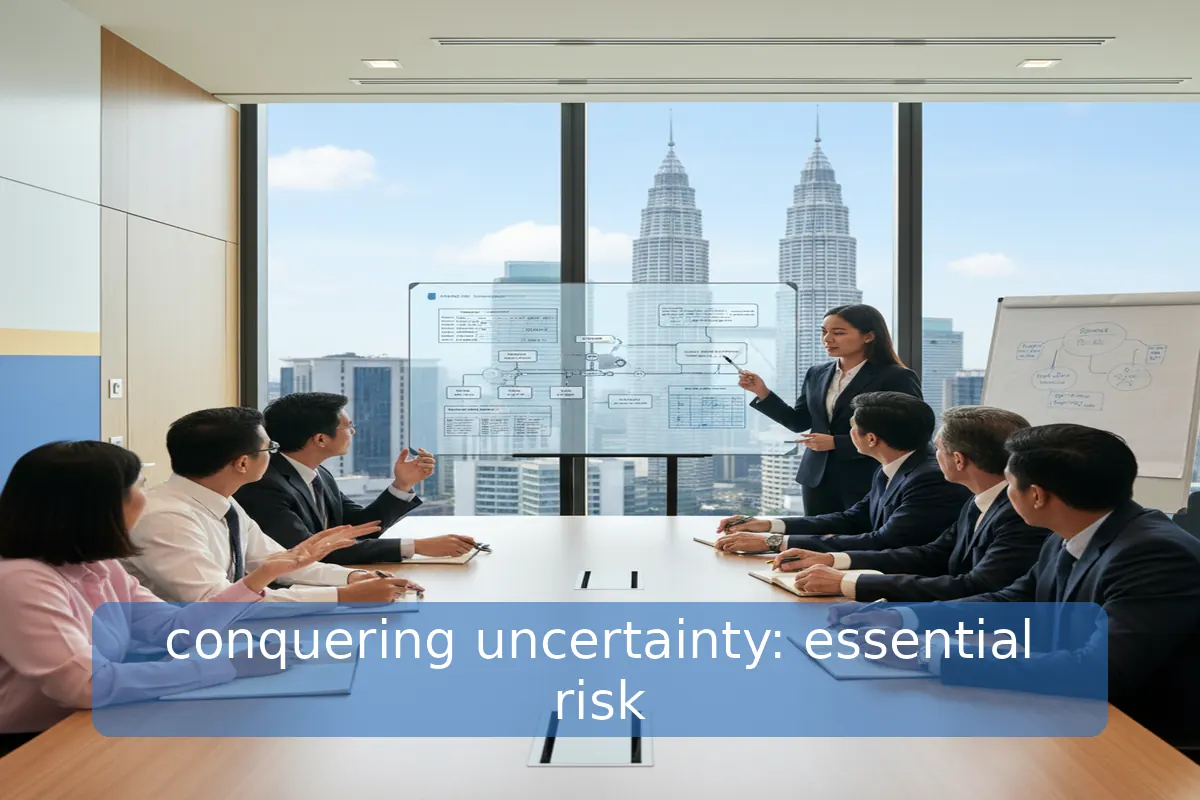
In the dynamic business landscape of 2026, mastering risk management strategies is non-negotiable for achieving project success. This involves systematically identifying, analyzing, and responding to potential threats and opportunities that can impact project objectives, whether in established markets like the UK or rapidly evolving regions such as Malaysia. Effective risk management transforms uncertainty into a manageable factor, safeguarding resources, timelines, and desired outcomes, thereby ensuring projects remain on track and deliver anticipated value.
Quick Summary
- Robust risk management is vital for project success in 2026
- Proactive strategies identify, assess, and mitigate potential threats
- Effective communication and technology are key enablers
- A structured framework enhances project resilience and outcomes
How Can Robust Risk Management Drive Project Success in 2026?
In 2026, global markets continue to present a complex interplay of geopolitical shifts, technological advancements, and evolving regulatory landscapes. For project managers, particularly those navigating diverse environments, risk management isn’t just about avoiding failure; it’s a strategic imperative for unlocking opportunities and ensuring resilience. By embedding a strong risk culture, organisations can not only protect their investments but also gain a competitive edge.
The strategic benefits of integrating robust risk management include:
-
Enhanced Decision-Making: With a clear understanding of potential risks and their impact, project leaders can make informed choices, allocate resources more effectively, and pivot strategies when necessary. This is especially critical in fast-paced sectors where data-driven decisions differentiate leaders from followers.
-
Improved Project Predictability and Control: Proactive risk management reduces unforeseen disruptions, leading to more accurate forecasting of project timelines, budgets, and resource needs. This control is vital for maintaining stakeholder confidence and adhering to delivery commitments.
-
Optimised Resource Allocation: Identifying critical risks early allows for the strategic deployment of resources to areas of highest vulnerability or potential impact, preventing costly reworks or delays. This aligns with principles taught in BMC Training‘s “Successful Planning, Organising and Delegating” course.
-
Increased Stakeholder Confidence: Transparent risk reporting and clear mitigation plans assure sponsors, investors, and team members that potential challenges are being actively managed, fostering trust and support.
-
Fostering a Culture of Proactivity: When risk management is ingrained, teams become more vigilant, identifying potential issues before they escalate. This cultural shift promotes continuous improvement and innovation, core tenets of “Continuous Innovation and Process Improvement.”
-
Competitive Advantage: Organisations adept at managing uncertainty are better positioned to seize opportunities, adapt to market changes, and deliver complex projects successfully where others might falter.
What Are the Core Stages of Effective Project Risk Management?
Effective project risk management is a cyclical, systematic process, not a one-off event. It integrates seamlessly into the entire project lifecycle, from initiation to closure. Understanding these core stages is fundamental to building a resilient project framework.
-
Risk Identification:
- Purpose: To uncover, acknowledge, and describe potential risks that could affect the project.
- Techniques: Brainstorming, Delphi technique, SWOT analysis, root cause analysis, checklist analysis, interviewing stakeholders, expert judgment, historical data review.
- Output: A comprehensive list of potential risks, often documented in a Risk Register. Each risk should be clearly defined, including its potential cause and effect.
- Example: For a software development project, identified risks might include “unclear user requirements,” “third-party API integration failures,” or “insufficient testing resources.”
-
Risk Analysis (Qualitative & Quantitative):
- Purpose: To understand the nature of identified risks and determine their potential impact and likelihood.
- Qualitative Analysis: Prioritises risks for further action by assessing their probability of occurrence and potential impact on project objectives (scope, schedule, cost, quality). Uses tools like a Risk Matrix.
- Quantitative Analysis: Numerically analyses the effect of identified risks on overall project objectives. Techniques include Monte Carlo simulations, decision tree analysis, and sensitivity analysis to estimate the financial impact or schedule delay.
- Output: Prioritised risks, often categorised by severity, and a deeper understanding of their potential implications.
-
Risk Response Planning:
- Purpose: To develop options and actions to enhance opportunities and reduce threats to project objectives.
- Strategies for Threats (Negative Risks):
- Avoid: Eliminate the threat by changing the project plan (e.g., altering scope, using proven technology).
- Transfer: Shift the impact and ownership of the risk to a third party (e.g., insurance, outsourcing).
- Mitigate: Reduce the probability or impact of a risk event to an acceptable threshold (e.g., additional testing, contingency planning, training).
- Accept: Acknowledge the risk and decide not to take any action unless the risk occurs. This can be passive (do nothing) or active (develop a contingency plan).
- Strategies for Opportunities (Positive Risks):
- Exploit: Take direct action to ensure the opportunity occurs (e.g., assigning talented resources).
- Enhance: Increase the probability or positive impact of an opportunity (e.g., adding resources).
- Share: Allocate ownership to a third party best able to capture the opportunity (e.g., joint ventures).
- Accept: Acknowledge the opportunity and decide not to pursue it actively.
- Output: Defined risk owners, specific response actions, contingency plans, and fallback plans.
-
Risk Implementation:
- Purpose: To carry out the agreed-upon risk response plans.
- Actions: Execute mitigation activities, trigger contingency plans if risks materialise, and communicate updates to stakeholders. This stage requires strong leadership and communication skills, as emphasised in BMC Training’s “Leadership and Strategic Impact” course.
- Output: Proactive management of risks as they emerge, preventing or minimising their impact.
-
Risk Monitoring and Control:
- Purpose: To track identified risks, monitor residual risks, identify new risks, ensure the effectiveness of risk response plans, and evaluate the overall risk process.
- Techniques: Risk audits, variance and trend analysis, technical performance measurement, reserve analysis, regular risk reviews.
- Output: Updated risk register, performance reports, change requests, and continuous improvement of the risk management process. This ensures that risk management remains dynamic and responsive throughout the project lifecycle.
Which Mitigation Strategies Best Safeguard Your Project Objectives?
Choosing the right risk mitigation strategy depends heavily on the nature of the risk, its potential impact, and the resources available. A balanced approach often involves a combination of strategies. Here’s a comparison of common mitigation strategies for negative risks (threats):
For project managers in 2026, the key is to develop a robust Risk Response Plan that clearly outlines which strategy applies to each significant risk, who is responsible for its execution, and what resources are required. This plan should be integrated into the overall project management plan and regularly reviewed.
What Common Pitfalls Should Project Managers Avoid in Risk Management?
Even with the best intentions, project risk management can stumble if common mistakes are not recognised and actively avoided. As a seasoned expert, I’ve observed several recurring pitfalls that can undermine even the most diligent efforts, particularly in dynamic environments like those seen in 2026.
-
Ignoring the “Unknown Unknowns”: While impossible to identify precisely, neglecting to build flexibility and contingency into plans for truly unforeseen events is a major error. Many teams focus only on “known unknowns.”
- Correction: Implement robust organisational resilience strategies, maintain contingency reserves (time and budget), and foster an agile mindset capable of rapid adaptation. BMC Training’s “Organisational Resilience” course directly addresses this.
-
Treating Risk Management as a One-Off Exercise: Risk management is often front-loaded and then forgotten. Risks evolve throughout the project lifecycle.
- Correction: Integrate risk reviews into every project phase meeting. Make it an ongoing, continuous process, not just a box-ticking activity at the beginning.
-
Lack of Stakeholder Engagement: Failing to involve key stakeholders (sponsors, team members, end-users, regulatory bodies) in risk identification and response planning leads to overlooked risks and lack of buy-in for mitigation.
- Correction: Conduct regular risk workshops with a diverse group of stakeholders. Ensure clear communication channels are established, as discussed in “High Impact Business Communication.”
-
Over-Reliance on Qualitative Analysis: While qualitative analysis is crucial for prioritisation, stopping there can lead to a superficial understanding of true impact, especially for complex projects.
- Correction: For high-priority risks, invest in quantitative risk analysis to model potential financial and schedule impacts more precisely. This provides a data-driven basis for executive decisions.
-
Focusing Only on Threats, Neglecting Opportunities: Risk management is often seen solely as a defensive activity. Opportunities, or positive risks, are frequently overlooked.
- Correction: Actively identify and plan for opportunities using strategies like exploit, enhance, or share. This can lead to increased value or competitive advantage.
-
Assigning Risks Without Ownership: A risk without a designated owner is a risk that won’t be managed. Ownership entails responsibility for monitoring and executing the response plan.
- Correction: Clearly assign a risk owner for each significant risk in the risk register, empowering them with the authority and resources needed.
-
Inadequate Communication of Risks: Risks and their status are often poorly communicated, leading to surprises, misaligned expectations, and a reactive environment.
- Correction: Establish clear risk communication plans, including regular updates to relevant stakeholders. Use visual aids like dashboards to convey risk status effectively.
How Can You Implement a Dynamic Risk Management Framework?
A dynamic risk management framework is essential for projects operating in today’s complex and uncertain environments. It moves beyond static documents to create a living system that adapts as the project progresses. Here’s a practical checklist for implementing such a framework:
-
Establish a Clear Risk Management Plan:
- Define the scope of risk management for the project.
- Outline roles, responsibilities, and authorities (e.g., who identifies, analyses, owns, and approves responses).
- Determine the methodology, tools, and data sources to be used.
- Set thresholds for risk tolerance and acceptable levels of exposure.
- Specify reporting formats and frequency.
-
Develop a Comprehensive Risk Register:
- Initial Setup: Create a centralised, accessible repository for all identified risks.
- Key Fields: Include unique ID, description, category, root cause, potential impact, likelihood, owner, current status, response strategy, contingency plan, trigger events, and residual risk.
- Version Control: Ensure the register is always up-to-date with clear versioning.
-
Integrate Risk Management into Project Lifecycle:
- Kick-off: Conduct initial risk identification workshops.
- Planning: Incorporate risk response planning into schedule and budget development.
- Execution: Regularly review and update the risk register in weekly/bi-weekly project meetings.
- Monitoring & Control: Use risk status reports as a key input for progress meetings and decision-making.
- Closure: Document lessons learned regarding risk management effectiveness.
-
Foster a Proactive Risk Culture:
- Training: Provide training on risk identification, analysis, and response for all team members. (BMC Training offers courses like “Effective Business Risk Management Strategies using ISO 31000 Framework“).
- Incentivise Reporting: Encourage team members to report potential risks and near-misses without fear of blame.
- Leadership Buy-in: Ensure project leadership visibly supports and champions proactive risk management.
-
Leverage Technology and Automation:
- Utilise project management software with integrated risk management modules.
- Explore AI/ML tools for predictive risk analysis based on historical data.
- Implement dashboards for real-time risk visibility and reporting.
-
Conduct Regular Risk Audits and Reviews:
- Periodically assess the effectiveness of the risk management process itself.
- Review the accuracy of risk assessments and the efficacy of response plans.
- Identify new risks and reassess existing ones.
- Ensure compliance with organisational policies and industry best practices (e.g., ISO 31000).
When Does Advanced Risk Management Software Make a Difference?
While foundational risk management can be handled with spreadsheets, advanced software solutions become indispensable for certain project complexities and organisational needs. Deciding when to invest in these tools is a strategic choice for project managers in 2026.
Advanced risk management software makes a significant difference when:
-
You’re Managing Large, Complex Programs or Portfolios:
- Scenario: A multinational corporation overseeing dozens of interconnected projects across various regions (e.g., a major infrastructure development spanning several countries).
- Benefit: These tools provide a centralised view of risks across multiple projects, allowing for portfolio-level risk aggregation, dependency mapping, and resource conflict resolution. They can highlight systemic risks that individual project-level views might miss.
-
The Project Involves High Stakes and Significant Financial Exposure:
- Scenario: A large-scale energy project with a multi-billion-pound budget, where delays or failures could result in massive financial penalties or reputational damage.
- Benefit: Advanced software often includes robust quantitative risk analysis capabilities (e.g., Monte Carlo simulations for cost and schedule uncertainty), providing detailed probabilistic forecasts and helping to justify contingency reserves.
-
Regulatory Compliance is Critical and Complex:
- Scenario: Projects in highly regulated industries like finance, pharmaceuticals, or defence, requiring stringent adherence to standards (e.g., GDPR, ISO, industry-specific regulations).
- Benefit: These systems offer audit trails, automated compliance checks, and detailed reporting features that simplify regulatory reporting and demonstrate due diligence. They can integrate with Governance, Risk, and Compliance (GRC) platforms.
-
You Need Real-time Visibility and Proactive Alerts:
- Scenario: A fast-moving technology project where market conditions or technical challenges can change rapidly, requiring immediate risk status updates for decision-makers.
- Benefit: Dashboards, automated alerts, and integration with project management or enterprise resource planning (ERP) systems provide timely data, enabling quicker responses to emerging risks.
-
Standardisation and Consistency Across the Organisation are Priorities:
- Scenario: An organisation aiming to implement consistent risk management practices and reporting across all its departments and projects.
- Benefit: Software enforces standardised risk taxonomies, assessment methodologies, and reporting templates, ensuring uniformity and facilitating benchmarking and lessons learned across the enterprise.
For smaller, less complex projects, a well-maintained spreadsheet and diligent manual processes might suffice. However, as projects scale in size, complexity, or criticality, the efficiency, analytical power, and integrated capabilities of advanced software become a clear differentiator for successful risk navigation in 2026.
Expert Insight
“The true measure of a project manager’s skill in 2026 isn’t just about delivering on time and budget, but how adeptly they navigate the unforeseen. Risk management has evolved from a defensive chore into a strategic driver for competitive advantage. Those who embrace it proactively, fostering a culture of vigilance and adaptability, will be the ones consistently achieving project success and driving organisational growth.”
— Industry experts confirm that a proactive approach to risk management is central to modern project leadership.
Key Terms
-
Risk Register: A document that details all identified risks, their characteristics, analysis, and planned responses. It’s a living document updated throughout the project.
-
Risk Matrix: A visual tool used in qualitative risk analysis to plot risks based on their likelihood and impact, helping to prioritise them for response planning.
-
Contingency Plan: A pre-defined set of actions to be taken if a specific identified risk (a known-unknown) actually occurs, to minimise its negative impact.
-
Residual Risk: The amount of risk remaining after risk response strategies have been implemented. It’s the risk that the project team is willing to accept.
-
Risk Appetite: The degree of uncertainty an organisation or individual is willing to accept in anticipation of a reward. It guides risk response planning.
How Can BMC Training Support Your Professional Growth?
In the intricate landscape of project management in 2026, the ability to effectively manage risks is a cornerstone of professional excellence. BMC Training offers a comprehensive suite of courses designed to equip you with the advanced skills and strategic mindset needed to conquer uncertainty and drive project success. Our programmes, delivered by seasoned industry experts, go beyond theoretical concepts, providing practical, actionable frameworks directly applicable to real-world challenges—whether you’re leading projects in London, Manchester, or globally in dynamic markets like Malaysia.
Consider our specialized courses such as “Effective Business Risk Management Strategies using ISO 31000 Framework,” “Strategic Crisis Management,” or “Project Management Essentials” to deepen your understanding and refine your execution capabilities. For leaders, “Leadership and Decision-Making in Crisis and Emergency Situations” or “Strategic Planning, Communication, Measurement and Implementation” provide holistic approaches to managing uncertainty at an organisational level. We focus on developing not just knowledge, but the practical experience and confidence to apply it, ensuring you can proactively identify, assess, and mitigate risks, turning potential threats into opportunities for your projects and your career. Invest in your expertise with BMC Training and become an indispensable asset in any project environment.
Frequently Asked Questions
Q: What is the primary purpose of risk management in projects?
Q: How does risk identification contribute to project success in 2026?
Q: What is the difference between risk mitigation and risk acceptance?
Q: Why is continuous monitoring crucial for effective risk management?
Q: How can communication enhance project risk management?
Q: What role does leadership play in fostering a proactive risk management culture?