

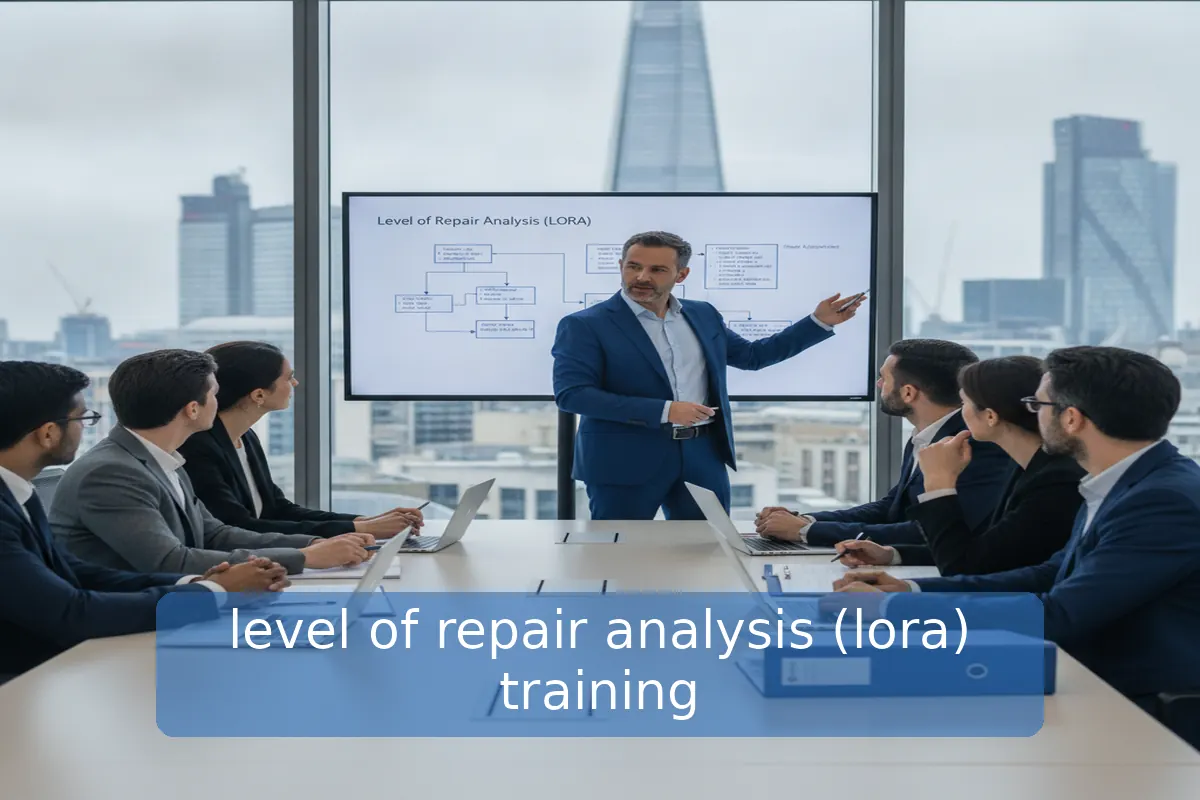
Level of Repair Analysis (LORA) is a crucial strategic methodology that systematically determines the most cost-effective and operationally efficient maintenance approach for complex equipment and systems. It evaluates whether an asset component should be repaired, replaced, or discarded at specific maintenance levels, considering factors like labour, spare parts, logistics, and downtime. For UK businesses in 2026, mastering LORA through specialised training is essential for optimising asset lifecycle costs, enhancing operational readiness, and making data-driven decisions that strengthen supply chain resilience and overall profitability in a competitive economic landscape.
Quick Summary
- LORA is a strategic methodology for optimising maintenance decisions
- it evaluates repair, replacement, or discard at various operational levels
- essential for UK businesses in 2026 to cut costs and boost readiness
- effective LORA integrates engineering, logistics, and financial data
What is Level of Repair Analysis (LORA) and Why is it Indispensable for UK Businesses in 2026?
Level of Repair Analysis (LORA) is a quantitative decision-making process that establishes the optimal maintenance strategy for complex systems, components, and parts throughout their lifecycle. It goes beyond simple repair-or-replace choices, delving into where (at what echelon of maintenance) and how (what resources) these actions should be performed to achieve the lowest overall cost and highest operational availability. For UK organisations navigating a dynamic 2026 economic and regulatory environment, LORA isn’t just a best practice; it’s a strategic imperative.
Key reasons LORA is indispensable for UK businesses:
-
Optimised Lifecycle Costs: LORA considers the full spectrum of costs, from initial procurement and spare parts inventory to labour, transportation, and disposal. By identifying the most economical repair level (e.g., organisational, intermediate, or depot), businesses can significantly reduce total cost of ownership (TCO) over an asset’s lifespan.
-
Enhanced Operational Readiness & Uptime: By streamlining maintenance processes and ensuring critical components are repaired or replaced efficiently, LORA directly contributes to higher equipment availability. This is vital for sectors in the UK such as defence, transportation, manufacturing, and energy, where downtime can have severe financial and operational consequences.
-
Data-Driven Decision Making: LORA provides a robust framework for making objective, defensible maintenance decisions based on comprehensive data analysis rather than intuition. This ensures resources are allocated optimally and risks are mitigated effectively.
-
Supply Chain Resilience: In an era of unpredictable global supply chains, LORA helps UK businesses strategically position spares and repair capabilities. It identifies which items are critical for local repair versus those that can be economically sent off-site, reducing reliance on distant suppliers and improving response times.
-
Sustainability & Environmental Impact: By promoting repair over discard where feasible and cost-effective, LORA can contribute to reduced waste and a more sustainable operational footprint, aligning with growing environmental, social, and governance (ESG) objectives prevalent in the UK.
-
Compliance & Risk Management: For industries with stringent safety and performance regulations, LORA ensures that maintenance strategies meet compliance requirements while managing the financial risks associated with complex asset portfolios.
How Do You Conduct a Robust Level of Repair Analysis (LORA) for Optimal Asset Management?
Conducting a thorough Level of Repair Analysis (LORA) is a multi-step process that demands meticulous data collection, rigorous analysis, and cross-functional collaboration. The methodology is often guided by standards such as MIL-HDBK-1390, which provides a comprehensive framework, particularly for defence and complex industrial systems.
Here’s a structured approach to conducting a robust LORA:
-
Define the Scope and Objectives:
- Identify the System/Asset: Clearly delineate the specific equipment, system, or component that will undergo LORA.
- Establish Goals: Define what the LORA aims to achieve (e.g., reduce lifecycle costs by 15%, increase operational availability by 10%, optimise spare parts inventory).
- Define Maintenance Echelons: Determine the existing or proposed levels of maintenance (e.g., field-level, intermediate shop, depot-level repair).
-
Gather Comprehensive Data:
- Technical Data: Engineering drawings, specifications, bills of material, mean time between failures (MTBF), mean time to repair (MTTR), failure modes and effects analysis (FMECA) results.
- Cost Data: Labour rates (per echelon), material costs (spare parts, consumables), transportation costs, tooling and test equipment costs, facility costs, administrative overheads.
- Logistics Data: Supply chain lead times, inventory holding costs, packaging, handling, storage, and transportation (PHS&T) requirements.
- Operational Data: Utilisation rates, mission criticality, desired operational availability, environmental conditions.
-
Develop Maintenance Task Analysis (MTA):
- Breakdown to Lowest Repairable Unit: Identify all components that can be repaired or replaced.
- Define Maintenance Tasks: For each component, detail all potential maintenance tasks (inspection, adjustment, repair, replacement).
- Estimate Task Resources: Quantify labour hours, special tools, and skill sets required for each task at each maintenance echelon.
-
Perform Economic and Non-Economic Analysis:
- Cost Models: Apply LORA algorithms (often supported by specialised software) to calculate the total cost for each repair alternative (repair at various levels vs. discard). This usually involves comparing the “cost-of-repair” against the “cost-of-replacement” at each echelon.
- Sensitivity Analysis: Evaluate how changes in key variables (e.g., failure rates, labour costs, spare parts prices) impact the optimal repair level decision.
- Non-Economic Factors: Integrate critical non-cost considerations like mission criticality, safety implications, environmental regulations, political constraints, and strategic self-sufficiency.
-
Evaluate Alternatives and Make Decisions:
- Compare Scenarios: Analyse the output of the cost models and non-economic factors to identify the most advantageous repair level for each component.
- Iterative Process: LORA is often iterative. Initial findings may necessitate refining data inputs or re-evaluating assumptions.
- Document Decisions: Clearly record the rationale for each repair level decision, including all supporting data and assumptions.
-
Implement and Monitor:
- Develop Support Plan: Based on LORA decisions, establish detailed logistics, supply chain, training, and facility support plans.
- Integrate with Systems: Update maintenance management systems (CMMS/EAM) with the new repair level policies.
- Continuous Review: Periodically review and update LORA decisions as operational conditions, costs, technology, or asset performance changes.
Which LORA Training Course is Right for Your UK Team? Evaluating Options and Expertise.
Selecting the appropriate Level of Repair Analysis (LORA) course is crucial for ensuring your team gains practical, actionable skills tailored to your organisation’s needs. Given the diverse applications of LORA, from defence to commercial manufacturing, training options vary widely.
When evaluating LORA training courses, consider the following:
-
Target Audience and Existing Knowledge: Is the course designed for beginners, experienced logisticians, engineers, or managers?
-
Curriculum Depth: Does it cover theoretical foundations, practical application, specific software, or a blend?
-
Industry Focus: Is it generic or tailored to specific sectors (e.g., aerospace, maritime, oil & gas, general manufacturing)?
-
Delivery Method: Classroom, online live, self-paced e-learning?
-
Accreditation & Recognition: Is the provider reputable? Are there certifications offered?
Here’s a comparison of typical LORA training course types:
Choosing the Right Provider:
When selecting a provider for your level of repair analysis course in the UK, look for:
-
Experienced Instructors: Trainers who have real-world experience applying LORA in complex environments.
-
Practical Case Studies: Courses that use relevant UK-based or international industry examples to illustrate concepts.
-
Customisation Options: The ability to tailor content to your organisation’s specific assets or industry.
-
Post-Course Support: Access to resources, templates, or instructor follow-up.
Integrating LORA with Other Maintenance Strategies: RCM, FMECA, and Predictive Maintenance
Level of Repair Analysis (LORA) is not a standalone solution but rather a powerful tool that achieves its full potential when integrated with other maintenance and reliability strategies. Understanding these synergies is key to developing a holistic asset management approach.
LORA vs. RCM vs. FMECA: Choosing the Right Maintenance Strategy for Your UK Business
While all three methodologies aim to optimise asset performance and reliability, they address different aspects:
-
Failure Modes, Effects, and Criticality Analysis (FMECA):
- Focus: Identifies potential failure modes within a system, their causes, effects, and criticality. It’s a foundational analysis for understanding what can fail and how it affects the system.
- Relationship with LORA: FMECA outputs (e.g., failure rates, criticality ratings, recommended maintenance tasks) are crucial inputs for LORA. LORA uses FMECA data to determine the optimal repair level for components identified as critical or prone to specific failure modes.
- When to Use: Early in design, or when seeking to understand failure mechanisms and their impact.
-
Reliability-Centred Maintenance (RCM):
- Focus: Determines the most effective maintenance tasks required to preserve system functions. It asks: “What functions must the asset perform, what failures can prevent these functions, and what is the most effective way to prevent these failures?”
- Relationship with LORA: RCM identifies what maintenance tasks should be performed (e.g., preventive, predictive, run-to-failure). LORA then takes these identified tasks and determines where (at what level) and how (with what resources) those tasks should be executed most cost-effectively. RCM defines the “what,” LORA defines the “where” and “how.”
- When to Use: To define an optimal maintenance program for critical assets, focusing on function preservation.
-
Level of Repair Analysis (LORA):
- Focus: Determines the most cost-effective and operationally efficient level at which to repair, replace, or discard an item. It addresses the “where” and “how” of maintenance strategy.
- When to Use: After FMECA has identified potential failures and RCM has defined necessary maintenance tasks, LORA provides the economic and logistical justification for how and where those tasks should be performed.
Synergy with Predictive Maintenance (PdM):
Predictive Maintenance technologies (e.g., condition monitoring, IoT sensors, AI-driven analytics) complement LORA by providing real-time data on asset health.
-
Enhanced LORA Inputs: PdM data can refine LORA’s input parameters by providing more accurate failure rates, remaining useful life estimates, and insights into specific component degradation. This leads to more precise LORA models.
-
Dynamic LORA Adjustments: As PdM identifies impending failures, LORA decisions can be dynamically revisited. For example, a component previously designated for depot-level repair might, under specific real-time conditions, be more economically repaired at an intermediate level if a window of opportunity arises, or vice-versa.
-
Optimised Spares & Logistics: PdM allows for “just-in-time” procurement of spare parts based on actual condition, rather than fixed schedules. LORA can then guide the optimal stocking level and location of these spares, ensuring they are available at the most cost-effective maintenance echelon when needed.
By integrating LORA with FMECA, RCM, and PdM, UK businesses can move towards a truly optimised, data-driven, and resilient asset management strategy, maximising uptime while minimising costs.
What Common Pitfalls Should You Avoid When Implementing LORA?
Implementing Level of Repair Analysis (LORA) effectively requires careful planning and execution. Many organisations, despite good intentions, fall into common traps that can undermine the analysis’s value and lead to suboptimal outcomes. Being aware of these pitfalls is the first step to avoiding them.
-
Poor Data Quality and Availability:
- Pitfall: Relying on incomplete, inaccurate, or outdated data for failure rates, repair times, labour costs, or spare part prices. LORA is highly data-intensive, and “garbage in, garbage out” applies rigorously.
- Avoid: Invest significant time upfront in data validation and collection. Establish robust data management processes. If historical data is scarce, use industry benchmarks with clear caveats, and plan for data collection during initial operations.
-
Insufficient Scope Definition:
- Pitfall: Either defining the scope too broadly (trying to analyse an entire complex system at once, leading to analysis paralysis) or too narrowly (missing critical interdependencies between components).
- Avoid: Clearly define the boundaries of the analysis. Start with a manageable subsystem or a critical asset family. Understand the interfaces and dependencies with other systems.
-
Lack of Cross-Functional Collaboration:
- Pitfall: Conducting LORA in a silo (e.g., purely by logistics or engineering departments) without input from operations, finance, procurement, or maintenance technicians. This leads to unrealistic assumptions and a lack of buy-in.
- Avoid: Form a dedicated LORA team with representatives from all relevant departments. Foster open communication and ensure all stakeholders understand their role and the impact of the analysis.
-
Ignoring Non-Economic Factors:
- Pitfall: Focusing exclusively on cost minimisation and neglecting critical non-economic considerations such as safety, mission criticality, political implications, environmental regulations, or strategic independence.
- Avoid: Systematically incorporate non-economic factors into the decision matrix. Assign weighting or use multi-criteria decision analysis techniques to balance cost with other strategic imperatives.
-
Static Analysis and Lack of Review:
- Pitfall: Treating LORA as a one-time event, failing to review and update the analysis as operational conditions, technology, costs, or asset performance change over time.
- Avoid: Establish a schedule for periodic LORA reviews (e.g., every 3-5 years, or upon significant design changes, operational shifts, or major cost fluctuations). Treat LORA as a living document.
-
Over-Reliance on Software Without Understanding the Fundamentals:
- Pitfall: Using sophisticated LORA software without a deep understanding of the underlying algorithms, assumptions, and data requirements. This can lead to misinterpretation of results or blind acceptance of flawed outputs.
- Avoid: Ensure all LORA practitioners receive comprehensive training on both the theoretical foundations of LORA and the practical application of any software tools. Understand the “why” behind the “what.”
By proactively addressing these common pitfalls, UK organisations can significantly enhance the accuracy, relevance, and impact of their Level of Repair Analysis efforts, leading to more robust and sustainable maintenance strategies.
Expert Insight
“Effective Level of Repair Analysis is far more than just a cost-cutting exercise; it’s a strategic enabler for operational resilience. In today’s complex operational landscape, particularly across UK industries, organisations that master LORA are better positioned to manage supply chain volatility, ensure mission readiness, and achieve long-term sustainability by making informed, defensible decisions about their most critical assets. It requires a blend of analytical rigour and a deep understanding of operational realities.”
— Industry Experts in Asset Management & Logistics
Crafting Your LORA Strategy: A Practical Decision Checklist for UK Operations
Developing and implementing an effective LORA strategy requires a systematic approach. This checklist provides a practical framework for UK organisations to guide their decision-making process, ensuring comprehensive coverage and optimal outcomes.
Pre-Analysis Phase – Setting the Foundation:
-
Define Clear Objectives: What specific problem are you trying to solve with LORA? (e.g., reduce maintenance budget by X%, improve uptime for asset Y, optimise spare parts holding for fleet Z).
-
Identify Key Stakeholders: Who needs to be involved? (e.g., engineering, maintenance, logistics, finance, operations, procurement, safety). Secure their buy-in and assign roles.
-
Determine Scope & Boundaries: Which assets or systems will be analysed? What are the physical and organisational limits of the analysis?
-
Assess Data Readiness: What data is available (technical, cost, operational)? What data needs to be collected or estimated? How will data quality be assured?
-
Select Methodology & Tools: Will you follow MIL-HDBK-1390 or another standard? Which LORA software (if any) will be used, and do you have the necessary licenses and training?
Analysis Phase – Execution and Evaluation:
-
Conduct Maintenance Task Analysis (MTA): Break down assets into repairable units and define all associated maintenance tasks and resource requirements at each echelon.
-
Gather Cost & Performance Data: Collect accurate, current data for labour, parts, tools, facilities, transportation, failure rates, and repair times for each maintenance echelon.
-
Model Repair Alternatives: For each component, model the costs and benefits of repairing at different echelons versus discarding/replacing.
-
Integrate Non-Economic Factors: Systematically evaluate and incorporate safety, mission criticality, environmental, political, and strategic considerations into the decision process.
-
Perform Sensitivity Analysis: Test how changes in key variables (e.g., labour costs, part prices, failure rates) impact the optimal repair level decision.
-
Review & Validate Results: Present preliminary findings to stakeholders. Challenge assumptions, refine models, and ensure the results are logical and defensible.
Post-Analysis & Implementation Phase – Action and Continuous Improvement:
-
Document Decisions & Rationale: Create a comprehensive LORA report detailing all decisions, supporting data, assumptions, and the justification for chosen repair levels.
-
Develop Implementation Plan: Outline specific actions required to enact the LORA decisions (e.g., changes to spare parts inventory, new tooling purchases, staff training, facility modifications).
-
Integrate with Existing Systems: Update your Computerised Maintenance Management System (CMMS) or Enterprise Asset Management (EAM) system with the new repair level policies.
-
Monitor Performance & KPIs: Track actual costs, uptime, spare parts consumption, and other relevant metrics against LORA predictions.
-
Schedule Periodic Reviews: Plan regular intervals (e.g., annually, biennially) to revisit and update the LORA as operational environments, technology, and economic conditions evolve.
By diligently following this checklist, UK organisations can develop a robust LORA strategy that yields tangible benefits in cost efficiency, operational availability, and overall asset management excellence.
How Does LORA Software Enhance Analysis and Decision-Making?
While the principles of Level of Repair Analysis (LORA) can be applied manually, the complexity of modern systems and the vast amounts of data involved make LORA software an invaluable tool. These specialised applications significantly enhance the speed, accuracy, and depth of the analysis, leading to more robust and defensible maintenance decisions.
Key benefits of utilising LORA software:
-
Automated Calculations & Modelling: LORA software automates the complex cost calculations, economic comparisons, and sensitivity analyses that would be extremely time-consuming and prone to human error if performed manually.
-
Data Integration & Management: These tools can integrate with existing databases (e.g., CMMS, ERP, inventory systems) to pull in relevant data like failure rates, repair times, labour costs, and spare part prices, ensuring consistency and reducing manual data entry.
-
Scenario Planning & Sensitivity Analysis: Software allows analysts to quickly run multiple “what-if” scenarios, testing the impact of changes in variables (e.g., increased labour costs, new part suppliers, different operational profiles) on the optimal repair level. This is critical for understanding risk and making resilient decisions.
-
Standardisation & Compliance: Many LORA software solutions are built to align with industry standards like MIL-HDBK-1390, ensuring a consistent and compliant approach to the analysis.
-
Visualisation & Reporting: LORA software typically offers powerful reporting and visualisation capabilities, making it easier to interpret complex results, present findings to stakeholders, and justify decisions. This clarity is vital for gaining buy-in from management and cross-functional teams.
-
Optimisation Algorithms: Advanced software often incorporates sophisticated optimisation algorithms that can identify the absolute most cost-effective solution across a vast number of repair alternatives, considering all constraints.
-
Lifecycle Cost Management: By providing a comprehensive view of costs associated with different repair levels, the software aids in better lifecycle cost management, from initial design considerations through to end-of-life.
When considering level of repair analysis software, look for features such as:
-
Customisable Cost Models: The ability to adapt cost parameters and formulas to your organisation’s specific accounting practices.
-
User-Friendly Interface: Intuitive navigation and data input to minimise training time and maximise efficiency.
-
Robust Reporting: Clear, customisable reports and graphical outputs for decision-makers.
-
Integration Capabilities: Compatibility with your existing enterprise systems (e.g., CMMS, EAM, supply chain management).
-
Scalability: Ability to handle analyses for a wide range of asset complexities and fleet sizes.
-
Vendor Support & Training: Reliable technical support and comprehensive training resources.
Examples of LORA software or modules often used include those from providers like Andromeda Systems Incorporated (e.g., OpSim or SLIC), or integrated modules within larger enterprise asset management (EAM) suites. Choosing the right software can significantly streamline your LORA process, transforming raw data into actionable insights for superior asset management.
Key Terms
-
Level of Repair Analysis (LORA): A systematic, quantitative methodology to determine the most cost-effective and operationally efficient level at which to repair, replace, or discard an item.
-
Maintenance Echelon: A distinct level within an organisation’s maintenance structure where specific types of maintenance tasks are performed (e.g., organisational, intermediate, depot).
-
MIL-HDBK-1390: A military handbook providing detailed guidance and procedures for conducting Level of Repair Analysis, often used as a benchmark in various industries.
-
Reliability-Centred Maintenance (RCM): A structured approach to determine the optimal maintenance tasks required to preserve system functions, focusing on preventing functional failures.
-
Failure Modes, Effects, and Criticality Analysis (FMECA): A systematic process for identifying potential failure modes in a system, their causes, effects, and criticality, informing maintenance strategies.
-
Supportability Analysis: A broad term encompassing various analyses (including LORA) aimed at ensuring that a system can be supported efficiently and effectively throughout its lifecycle.
How Can BMC Training Support Your Professional Growth?
At BMC Training, we understand that mastering Level of Repair Analysis (LORA) is critical for driving efficiency and resilience in today’s complex operational environments. Our expert-led Level of Repair Analysis training courses are meticulously designed for UK professionals, offering practical, hands-on learning experiences that translate directly into actionable skills. Whether you’re an engineer, logistician, maintenance planner, or strategic manager, our curriculum covers everything from foundational LORA principles, detailed cost modelling, adherence to standards like MIL-HDBK-1390, and the effective use of LORA software.
We connect LORA to a broader spectrum of essential skills, including Business Strategy Essentials, Continuous Innovation and Process Improvement, Data Management, Manipulation and Analysis, and Strategic Planning. By choosing BMC Training, you gain:
-
Deep Expertise: Learn from seasoned industry specialists with real-world LORA implementation experience.
-
Practical Application: Our courses emphasise case studies, exercises, and decision frameworks relevant to UK industries, ensuring you can immediately apply what you learn.
-
Strategic Insight: Understand how LORA influences not just maintenance, but also supply chain resilience, profitability, and overall organisational strategy.
-
Professional Development: Equip yourself with a highly sought-after skill that enhances career prospects and contributes directly to your organisation’s bottom line.
Invest in your team’s capability and your organisation’s future. Explore BMC Training’s comprehensive LORA offerings today and empower your UK operations to make smarter, more cost-effective maintenance decisions.
Frequently Asked Questions
Q: What is the main objective of Level of Repair Analysis (LORA)?
Q: Who should ideally attend Level of Repair Analysis training?
Q: Can Level of Repair Analysis be applied to software?
Q: How does Level of Repair Analysis impact the bottom line?
Q: Is Level of Repair Analysis relevant for small businesses?
Q: What is the difference between LORA and RCM in training?