

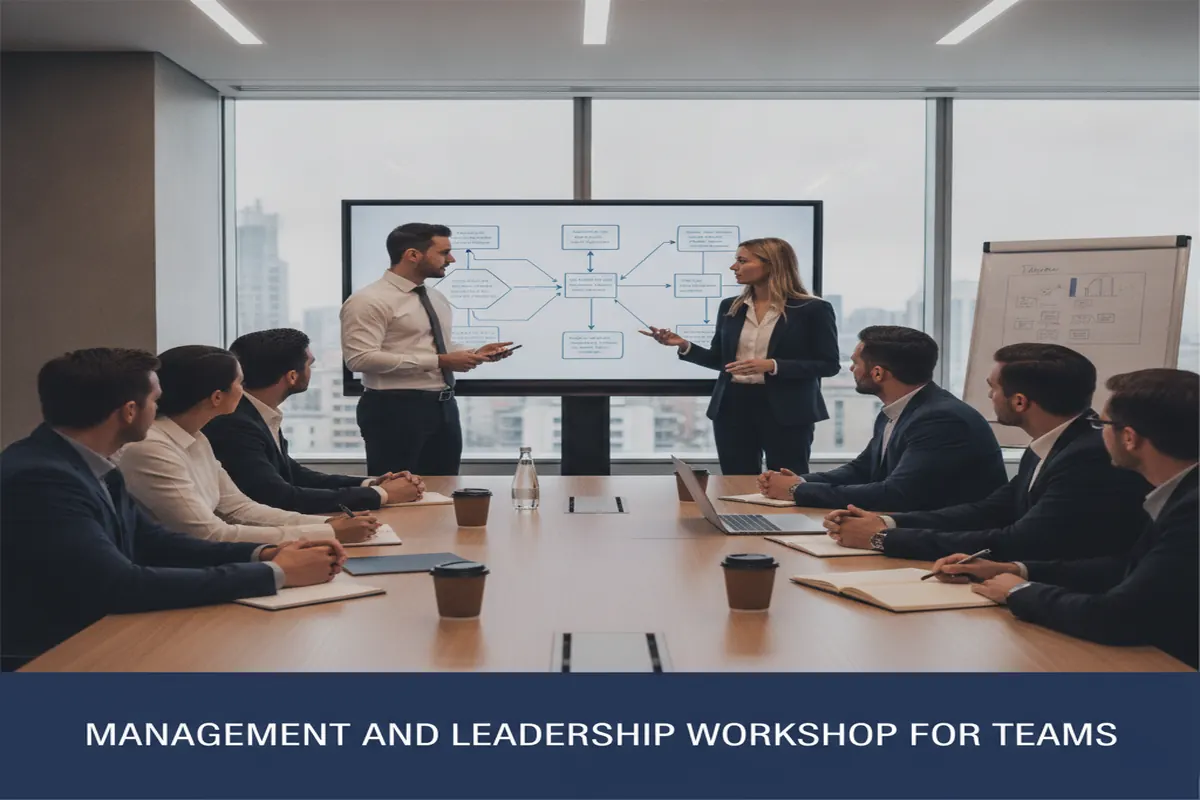
A management and leadership workshop for teams is a focused, interactive training program designed to equip groups of professionals with the essential skills and frameworks needed to effectively lead, manage, and collaborate. These workshops move beyond individual skill development, fostering a cohesive approach to leadership challenges, enhancing team dynamics, and driving collective organizational success. They address critical areas like communication, decision-making, conflict resolution, and strategic execution, ensuring teams are better prepared to navigate complex business environments and achieve shared objectives.
Quick Summary
- A management and leadership workshop for teams enhances collective capabilities
- it’s ideal for middle management and aspiring leaders
- benefits include improved communication, decision-making, and performance
- selecting the right workshop requires assessing content, format, and facilitator expertise
What is a Management and Leadership Workshop for Teams?
At its core, a management and leadership workshop for teams is an immersive learning experience tailored to develop both individual leadership competencies and the collective management capabilities of a group. Unlike individual coaching or general management seminars, these workshops are specifically crafted for teams – whether they are departmental units, project groups, or cross-functional collaborations. The emphasis is on practical application, shared understanding, and fostering a common language and approach to leadership challenges within a specific organizational context.
These workshops typically combine theoretical knowledge with hands-on exercises, group discussions, role-playing, and case studies. The goal is not just to impart information but to cultivate actionable skills that can be immediately applied back in the workplace. They serve as a vital tool for organizations looking to strengthen their internal leadership pipeline, improve team cohesion, and drive sustained performance.
Key components often include:
-
Understanding Leadership Styles: Exploring various leadership models and how different styles impact team dynamics and outcomes.
-
Effective Communication: Developing strategies for clear, concise, and persuasive communication within the team and with external stakeholders. (See also: High Impact Business Communication)
-
Decision-Making Frameworks: Learning structured approaches to problem-solving and making informed decisions under pressure.
-
Conflict Resolution: Acquiring techniques to identify, address, and resolve interpersonal and team conflicts constructively.
-
Strategic Planning & Execution: Aligning team efforts with broader organizational goals and effectively translating strategy into action. (Relevant: Strategic Planning, Development and Implementation)
-
Delegation & Empowerment: Mastering the art of delegating tasks effectively to foster growth and increase team autonomy.
-
Feedback & Coaching: Building skills to provide constructive feedback and coach team members for continuous improvement.
Who Benefits Most from a Team Management and Leadership Workshop?
While any team can benefit from enhanced management and leadership capabilities, certain groups and roles stand to gain the most significant impact from a dedicated workshop. These programs are not just for senior executives; they are particularly powerful for the layers of an organization responsible for day-to-day operations and team guidance.
Here are the primary beneficiaries:
-
Middle Management: Often referred to as the “linchpins” of an organization, middle management plays a crucial role in translating strategic vision into operational reality. They manage teams directly, implement policies, and are responsible for performance. Workshops help them refine their leadership presence, enhance delegation skills, and improve their ability to motivate and manage diverse teams. Courses like The Management Essentials or Leadership and Management Skills for Supervisors are highly relevant here.
-
Team Leaders and Supervisors: Individuals newly promoted to leadership roles or those needing to solidify their foundational skills will find immense value. These workshops provide practical tools for team building, performance coaching, and fostering a positive team environment. This includes developing skills in Successful Planning, Organising and Delegating.
-
Project Managers: Leading projects often means managing cross-functional teams without direct authority. Project managers benefit from workshops that focus on influence, negotiation, and motivating temporary teams to achieve specific project goals. (Consider: Project Leadership – Developing Skills to Assist in Conflict Resolution)
-
High-Potential Employees and Aspiring Leaders: Identifying and nurturing future leaders is critical for organizational sustainability. These workshops provide a structured environment for high-potential individuals to develop foundational leadership skills and understand the complexities of team management before stepping into formal roles.
-
Cross-Functional Teams: Teams formed to tackle specific initiatives or projects that span multiple departments often face unique challenges in coordination and communication. Workshops help them establish common goals, improve inter-departmental collaboration, and streamline decision-making processes.
-
Teams Undergoing Significant Change: During periods of change management, such as mergers, acquisitions, or digital transformations, teams can experience uncertainty and resistance. Leadership workshops can equip team leaders and members with the skills to navigate change effectively, communicate vision, and maintain morale and productivity. (Relevant: Advanced Conflict Resolution and Change Management Strategies)
In essence, if a group of individuals needs to work more cohesively, communicate more effectively, and collectively drive better results, a management and leadership workshop is a strategic investment.

The Transformative Benefits of Investing in Team Leadership Training
Investing in a specialized management and leadership workshop for teams yields a cascading array of benefits that extend far beyond individual skill enhancement. These programs are designed to cultivate a more robust, adaptable, and high-performing organizational culture, directly impacting both morale and the bottom line.
Here are the key transformative benefits:
-
Enhanced Team Cohesion and Collaboration: Workshops break down silos, foster mutual understanding, and build stronger interpersonal relationships within teams. Participants learn to appreciate diverse perspectives and leverage individual strengths for collective success, leading to more effective team building and project execution.
-
Improved Communication Channels: By providing common communication frameworks and practice opportunities, workshops significantly improve how teams share information, provide feedback, and resolve misunderstandings. This reduces miscommunication, boosts transparency, and ensures everyone is aligned. (Relevant: Communication Essentials)
-
More Effective Decision-Making: Teams learn structured approaches to problem-solving and decision-making, moving beyond intuition to data-driven, collaborative choices. This leads to better outcomes and increased confidence in team-level autonomy.
-
Boosted Employee Engagement and Morale: When leaders are well-equipped to manage and inspire, team members feel more valued, understood, and motivated. Effective leadership fosters a positive work environment, reducing turnover and increasing overall job satisfaction.
-
Increased Productivity and Performance: With clearer leadership, better communication, and improved collaboration, teams can operate more efficiently. Goals are better defined, tasks are delegated more effectively, and obstacles are addressed proactively, leading to measurable improvements in performance management. (Consider: Improving Productivity and Employee Engagement thru Effective Front Line Leadership)
-
Stronger Change Management Capabilities: Teams exposed to leadership training are better prepared to adapt to and even drive organizational change. Leaders learn to articulate the vision for change, manage resistance, and guide their teams through transitions smoothly, minimizing disruption. (See also: Strategic Crisis Management)
-
Development of a Unified Leadership Culture: When multiple leaders from the same organization attend, they develop a shared understanding of leadership principles and expectations. This creates a consistent leadership approach across departments, enhancing overall organizational effectiveness and reducing internal friction.
-
Cultivation of Future Leaders: These workshops serve as a crucial platform for identifying and developing high-potential individuals. By exposing them to advanced leadership concepts and practical challenges, organizations can build a robust pipeline of talent ready to step into greater responsibilities.
How to Choose the Right Management and Leadership Workshop for Your Team
Selecting the optimal management and leadership workshop requires careful consideration of your team’s specific needs, organizational context, and desired outcomes. A one-size-fits-all approach rarely yields the best results. Focus on aligning the workshop’s content, format, and facilitator expertise with your strategic objectives.
Here’s a framework to guide your decision:
1. Define Your Team’s Specific Needs and Objectives
Before even looking at programs, clearly articulate why your team needs this training.
-
Identify Pain Points: Are there recurring issues with communication, decision-making, conflict, or project execution?
-
Assess Skill Gaps: What specific leadership or management skills are lacking within the team or among its leaders? For instance, do they need to improve in performance management or change management?
-
Desired Outcomes: What tangible improvements do you expect to see after the workshop? Be specific (e.g., “reduce project delays by 15%,” “improve inter-departmental feedback scores”).
-
Target Audience: Is it for middle management, new supervisors, or a cross-functional project team? The content needs to resonate with their experience level and responsibilities.
2. Evaluate Workshop Content and Curriculum
Scrutinize the workshop agenda and learning modules.
-
Relevance: Does the content directly address your identified needs and objectives?
-
Practicality: Is there a strong emphasis on practical tools, techniques, and real-world application, rather than just abstract theory?
-
Customization Potential: Can the program be tailored to your industry, organizational culture, and specific challenges? This is especially crucial for in-house workshops.
-
Breadth vs. Depth: Does the workshop offer a comprehensive overview of leadership, or does it delve deeply into a specific area, such as Effective Organisational Leadership or Leadership and Strategic Impact?
3. Consider Workshop Format and Delivery
The mode of delivery significantly impacts engagement and learning retention.
4. Evaluate Facilitator Expertise and Experience
The quality of the facilitator can make or break a workshop.
-
Credentials and Experience: Do they have a strong background in leadership development, organizational psychology, or relevant industry experience?
-
Delivery Style: Is their approach engaging, interactive, and conducive to adult learning? Look for trainers who can adapt to group dynamics.
-
Practical Insights: Can they provide real-world examples and guide discussions based on practical experience, not just textbook knowledge?
5. Review Logistics and Post-Workshop Support
Don’t overlook the practicalities and follow-up.
-
Duration and Schedule: Does it fit your team’s availability? Is it a single intensive session or spread out over time?
-
Cost and Value: Compare pricing, but focus on the return on investment (ROI) in terms of improved team performance and morale.
-
Pre- and Post-Work: Are there assessments, preparatory materials, or follow-up resources (e.g., coaching, online modules) to reinforce learning? This is crucial for sustained impact.
-
Accreditation/Certification: Does the workshop offer any recognized certification or continuing professional development (CPD) credits?
By systematically addressing these criteria, you can confidently select a management and leadership workshop that truly empowers your team and delivers tangible value to your organization.
Common Pitfalls to Avoid When Selecting Team Leadership Workshops
Choosing a management and leadership workshop can be a significant investment, and avoiding common missteps is crucial for maximizing its impact. Many organizations fall into traps that dilute the effectiveness of their training efforts, leading to wasted resources and unfulfilled potential.
Here are critical pitfalls to watch out for and how to steer clear of them:
-
Ignoring a Clear Needs Assessment:
- Pitfall: Selecting a workshop based on a generic catalog description, competitor offerings, or simply because it “sounds good,” without first identifying the team’s specific challenges and skill gaps.
- Avoidance: Conduct a thorough needs assessment. Interview team members and leaders, analyze performance data, and identify precise areas for improvement. This ensures the workshop directly addresses real problems, such as gaps in performance management or change management capabilities.
-
Focusing Solely on “Soft Skills” Without Practical Application:
- Pitfall: Opting for programs that teach abstract concepts like “inspiration” or “vision” without providing concrete tools, frameworks, and opportunities for practice.
- Avoidance: Prioritize workshops with a strong practical component. Look for case studies, role-playing, simulations, and actionable takeaways that participants can immediately apply. The goal is to build capability, not just awareness.
-
Underestimating the Importance of Facilitator Quality:
- Pitfall: Choosing a workshop primarily based on cost or curriculum alone, overlooking the expertise, experience, and engaging style of the facilitator. A poor facilitator can undermine even the best content.
- Avoidance: Research potential facilitators. Look for strong testimonials, relevant industry experience, and a proven track record in adult learning. A skilled facilitator can adapt content, manage group dynamics, and ensure maximum engagement.
-
Neglecting Post-Workshop Reinforcement and Follow-Up:
- Pitfall: Treating the workshop as a one-off event, expecting immediate and permanent change without any follow-up or reinforcement mechanisms.
- Avoidance: Plan for post-workshop activities. This could include follow-up coaching, peer-to-peer learning groups, access to online resources, or regular check-ins to discuss application of learned skills. Sustainable change requires ongoing commitment. (Consider: Developing Personal Effectiveness with Positive Skills)
-
Failing to Secure Leadership Buy-in and Support:
- Pitfall: Sending teams to a workshop without the visible support and endorsement of senior leadership, which can signal that the training is not a priority.
- Avoidance: Ensure senior leaders communicate the importance of the training, participate in opening/closing remarks if possible, and actively champion the application of new skills. Leaders should model the behaviors they want to see.
-
Opting for Generic Content Instead of Tailored Solutions:
- Pitfall: Assuming a general “leadership training” will suffice, even when the team operates in a highly specialized industry or faces unique internal challenges.
- Avoidance: Seek out programs that can be customized or are specifically designed for your industry (e.g., oil and gas, healthcare, finance). Customization ensures the content, examples, and discussions are highly relevant to your team’s daily reality. (Relevant: Leadership and Strategic Thinking in the Oil and Gas Industry)
Decision-Making Checklist for Workshop Selection:
To help avoid these pitfalls, use this checklist before making your final decision:
-
Needs Clearly Defined? Have we identified specific team challenges and skill gaps?
-
Objectives Measurable? Can we articulate tangible, measurable outcomes for the workshop?
-
Content Relevant & Practical? Does the curriculum directly address our needs with actionable tools?
-
Facilitator Vetted? Is the trainer experienced, engaging, and relevant to our context?
-
Format Optimal? Is the delivery method (in-house, public, virtual) best for our team’s size and dispersion?
-
Post-Workshop Plan? Are there mechanisms for reinforcement and follow-up?
-
Leadership Endorsement? Do senior leaders actively support and champion this training?
-
Budget Aligned with Value? Are we considering ROI, not just upfront cost?
By diligently working through this checklist, organizations can significantly increase the likelihood of selecting a highly effective management and leadership workshop that delivers lasting value.
Beyond the Classroom: Where to Find High-Impact Team Leadership Workshops
Finding the right management and leadership workshop for your teams extends beyond a simple online search. High-impact training often comes from reputable providers with a proven track record, a deep understanding of organizational development, and the flexibility to adapt to diverse client needs. The “where” is as much about the provider’s philosophy and capabilities as it is about physical location.
Here are the key avenues for sourcing high-impact team leadership workshops:
-
Specialized Training and Development Firms (Like BMC Training):
- Description: These organizations focus exclusively on professional development, offering a broad portfolio of courses across various domains. They often employ a cadre of expert facilitators and have established methodologies.
- Advantages: Wide range of public courses, custom in-house solutions, deep expertise, global reach, and often offer certification. They are designed to be knowledge assets in their field.
- Considerations: Quality varies, so thoroughly vet credentials and client testimonials. Look for providers that emphasize practical application and measurable outcomes.
- Example: BMC Training offers a comprehensive suite of leadership and management programs, from The Essentials of Leadership to Leadership Excellence in Handling Pressure and Stress, available globally in various formats.
-
University Executive Education Programs:
- Description: Many top business schools offer executive education programs designed for working professionals. These can range from short, intensive workshops to longer certificate programs.
- Advantages: Academic rigor, access to leading faculty, networking opportunities with professionals from diverse industries, cutting-edge research.
- Considerations: Often more theoretical, higher cost, may require travel, and less customizable for specific team needs compared to dedicated training firms.
-
Professional Associations and Industry Bodies:
- Description: Organizations like the Project Management Institute (PMI) or local Chambers of Commerce often host workshops and seminars tailored to their members’ specific industry or professional needs.
- Advantages: Highly relevant content for niche industries, networking within your sector, often more affordable.
- Considerations: Scope might be narrower, quality can vary, and programs might be less comprehensive than those from dedicated training providers.
-
Management Consulting Firms (with Training Arms):
- Description: Some larger consulting firms offer leadership development as part of their broader service offerings, leveraging their insights into organizational challenges.
- Advantages: Can integrate training with broader strategic initiatives, deep understanding of specific organizational contexts if they are already a client.
- Considerations: Often very expensive, training might be a secondary focus, and their approach may be less standardized than dedicated training firms.
-
In-House Learning & Development (L&D) Departments:
- Description: For very large organizations, internal L&D teams may design and deliver workshops using internal subject matter experts or licensed content.
- Advantages: Highly customized, cost-effective for large employee bases, strong cultural fit.
- Considerations: May lack external perspective, limited by internal resources and expertise, can suffer from “prophet in your own land” syndrome.
When making a decision, consider the practical implications:
-
Geographic Reach: If your team is dispersed globally, a provider with international presence or robust virtual options is crucial. BMC Training, for instance, operates globally.
-
Delivery Flexibility: Do you need in-person, virtual, blended, or on-demand learning? The provider should offer formats that align with your team’s logistical constraints and learning preferences.
-
Track Record and Testimonials: Look for evidence of success. What do previous clients say? Are there case studies demonstrating impact?
-
Customization Capabilities: For optimal results, especially for middle management or change management initiatives, the ability to tailor content to your organization’s unique challenges is invaluable.
The “where” ultimately points to finding a partner who can deliver not just a workshop, but a valuable, impactful learning experience that translates into tangible improvements for your team and organization.
What Are the Prerequisites for Leadership? (And How Workshops Help Build Them)
The question “are the prerequisites for leadership” is fundamental, and it’s essential to understand that leadership isn’t solely an innate trait but a set of developable skills and characteristics. While some individuals may have a natural inclination, effective leadership is largely cultivated through experience, education, and deliberate practice. Management and leadership workshops for teams play a pivotal role in building these very prerequisites.
Here are the core prerequisites for leadership, and how workshops contribute to their development:
-
Self-Awareness:
- Prerequisite: Understanding one’s own strengths, weaknesses, values, and emotional triggers. This forms the foundation for authentic leadership.
- Workshop Contribution: Many programs incorporate self-assessment tools (e.g., personality inventories, 360-degree feedback) and reflective exercises that encourage introspection and provide objective insights into one’s leadership style and impact. Courses like Developing Personal Effectiveness with Positive Skills directly address this.
-
Strong Communication Skills:
- Prerequisite: The ability to articulate vision, provide clear instructions, listen actively, give constructive feedback, and inspire others.
- Workshop Contribution: Workshops dedicate significant time to communication theory and practice. Participants engage in role-playing, presentation exercises, and structured feedback sessions to hone their verbal, non-verbal, and written communication, crucial for team building and change management. (Relevant: Advanced Communication and Interpersonal Skills)
-
Emotional Intelligence (EQ):
- Prerequisite: The capacity to understand and manage one’s own emotions, as well as perceive and influence the emotions of others.
- Workshop Contribution: Programs often include modules on empathy, conflict resolution, motivating others, and managing stress. They help leaders understand how their emotional responses impact team dynamics and how to leverage EQ for better interpersonal interactions. (Consider: Mastering Emotional Intelligence – Skills for Excellent Leadership)
-
Decision-Making and Problem-Solving Acumen:
- Prerequisite: The ability to analyze complex situations, weigh options, make sound judgments, and adapt to unforeseen challenges.
- Workshop Contribution: Through case studies, simulations, and group exercises, participants learn structured decision-making frameworks, critical thinking skills, and how to lead teams through complex problem-solving processes. (Relevant: Advanced Problem Solving and Decision Making)
-
Strategic Thinking and Vision:
- Prerequisite: The capacity to see the bigger picture, anticipate future trends, and articulate a compelling direction for the team and organization.
- Workshop Contribution: Many workshops for middle management and aspiring leaders include modules on strategic planning, goal setting, and how to align team activities with broader organizational objectives. (See also: Strategy Design Bootcamp)
-
Delegation and Empowerment Skills:
- Prerequisite: The ability to effectively assign tasks, trust team members with responsibility, and foster a sense of ownership and accountability.
- Workshop Contribution: Leaders learn practical techniques for effective delegation, providing autonomy, and coaching team members to develop their own capabilities, which is vital for performance management. (Related: Successful Planning, Organising and Delegating)
-
Adaptability and Resilience:
- Prerequisite: The capacity to navigate uncertainty, learn from setbacks, and remain effective under pressure.
- Workshop Contribution: Through discussions on change management, crisis leadership scenarios, and stress management techniques, workshops help build mental toughness and flexibility. (Relevant: Leadership Excellence in Handling Pressure and Stress)
In essence, while some individuals may naturally possess more of these traits, a well-designed management and leadership workshop for teams provides the structured environment, expert guidance, and practical tools necessary to develop, refine, and integrate these critical prerequisites into a coherent and effective leadership style.
Expert Insight
“The modern leader must understand that their primary role is not just to manage tasks, but to cultivate an environment where teams can thrive autonomously. Leadership development for teams, particularly for middle management, is no longer a luxury but a strategic imperative for fostering organizational resilience and innovation. It’s about building collective intelligence and shared accountability.” – Industry experts on contemporary leadership development.
Key Terms
-
Leadership: The ability to inspire, influence, and guide individuals or teams toward a shared vision or goal, often involving strategic thinking and emotional intelligence.
-
Management: The process of planning, organizing, leading, and controlling resources (human, financial, material) to achieve organizational objectives efficiently and effectively.
-
Team Building: A process of enhancing social relations and defining roles within teams, often involving collaborative tasks, to improve performance and cohesion.
-
Change Management: A structured approach to transitioning individuals, teams, and organizations from a current state to a desired future state, focusing on human aspects of change.
-
Performance Management: A continuous process of setting objectives, monitoring progress, providing feedback, and developing employees to improve overall individual and organizational performance.
How Can BMC Training Support Your Professional Growth?
At BMC Training, we understand that effective management and leadership workshop for teams are not just about learning concepts; they’re about transforming capabilities and driving tangible organizational success. As a global leader in professional development, we offer a diverse portfolio of meticulously designed workshops, delivered by industry-leading experts, to address the unique challenges faced by teams and leaders in today’s dynamic environment.
Whether your focus is on empowering middle management, enhancing team building efforts, navigating complex change management initiatives, or optimizing performance management systems, BMC Training provides tailored solutions. Our programs are engineered for practical application, ensuring that every participant leaves with actionable strategies and a deeper understanding of the prerequisites for leadership. We offer flexible delivery options, including engaging in-person sessions, interactive virtual classrooms, and customized in-house training designed specifically for your organization’s context. Partner with BMC Training to invest in your team’s future, foster a culture of excellence, and achieve sustainable competitive advantage through unparalleled leadership development.
Frequently Asked Questions
Q: What is the ideal size for a management and leadership workshop for teams?
Q: How long do these workshops usually last?
Q: Can these workshops be customized for our specific industry or company culture?
Q: Are these workshops suitable for new managers or only experienced leaders?
Q: What kind of follow-up or support is typically provided after a workshop?
Q: How do we measure the effectiveness and ROI of a team leadership workshop?