


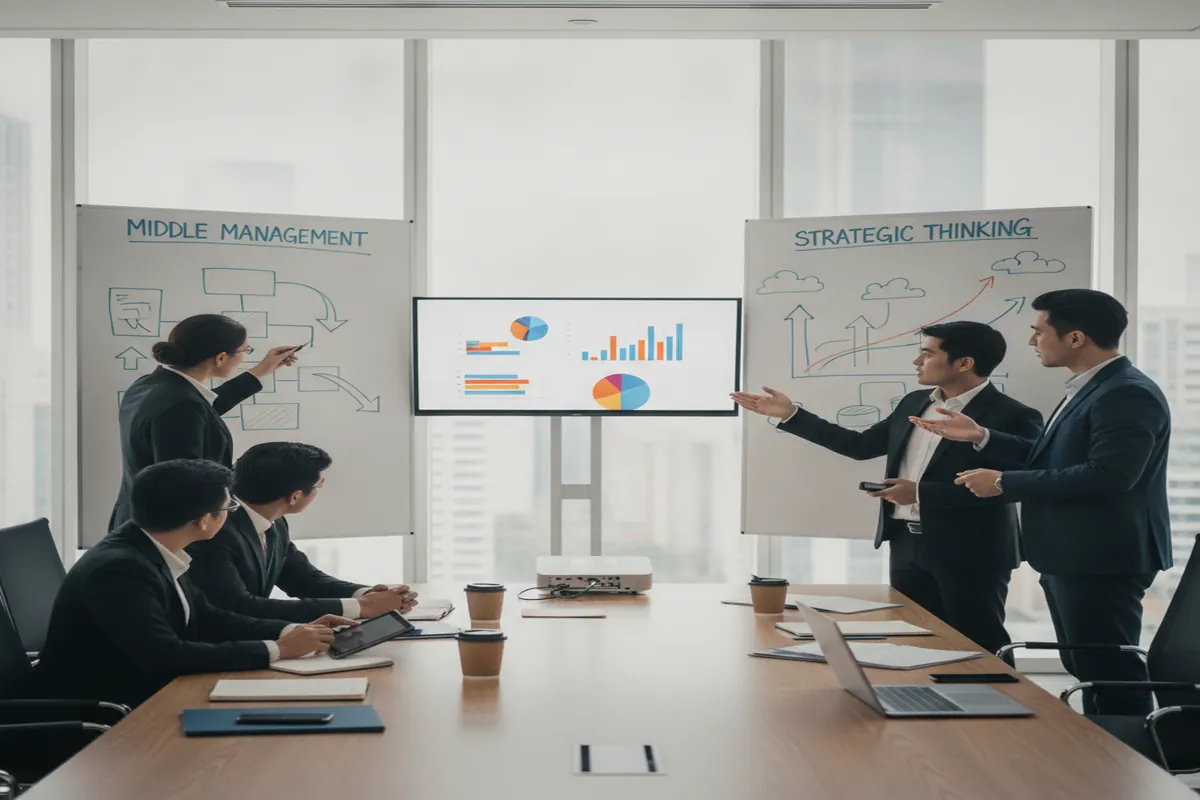
Middle management primarily focuses on the efficient execution of existing plans, processes, and directives to achieve short-to-medium term operational goals. In contrast, strategic thinking involves developing a long-term vision, anticipating future challenges and opportunities, and formulating overarching plans that guide an organization towards its desired future state. While distinct in their scope and focus, both functions are indispensable for an organization’s sustained success, requiring different skill sets and mindsets that can, and should, be integrated for optimal leadership.
Quick Summary
- Middle management focuses on executing current operations, while strategic thinking defines future direction and long-term goals
- one is primarily operational, the other visionary, but both are crucial for organizational success
- choosing involves assessing current organizational needs, individual career aspirations, and desired impact
- integrating both mindsets creates more effective leaders, fosters innovation, and builds resilient organizations
What are the Fundamental Distinctions Between Middle Management and Strategic Thinking?
The core differences between middle management and strategic thinking lie in their temporal focus, scope of influence, primary activities, and the ultimate objectives they serve. Middle managers operate within established frameworks, ensuring day-to-day operations run smoothly and teams meet their targets. Strategic thinkers, conversely, challenge existing paradigms, scan external environments, and envision new pathways for growth and adaptation, often influencing the very frameworks middle managers execute.
Here’s a breakdown of their key distinctions:
-
Time Horizon:
- Middle Management: Typically short to medium-term (weeks, months, quarters). Focused on current operational cycles and immediate performance.
- Strategic Thinking: Long-term (years, decades). Concerned with future positioning, sustainable growth, and market evolution.
-
Scope of Influence:
- Middle Management: Departmental, team-specific, or project-level. Focused on optimizing internal processes and team performance.
- Strategic Thinking: Organization-wide, market-level, or industry-level. Concerned with the overall direction and competitive landscape.
-
Primary Activities:
- Middle Management: Planning, organizing, staffing, directing, controlling, delegating tasks, performance management, resource allocation within budget.
- Strategic Thinking: Environmental scanning, visioning, goal setting, scenario planning, identifying core competencies, competitive analysis, innovation pipeline development.
-
Mindset:
- Middle Management: Practical, operational, problem-solving, efficiency-driven, detail-oriented.
- Strategic Thinking: Visionary, conceptual, analytical, creative, risk-aware, big-picture oriented.
-
Key Questions Addressed:
- Middle Management: “How do we achieve this goal efficiently?” “Are we meeting our targets?” “How do we fix this immediate issue?”
- Strategic Thinking: “Where are we going in 3-5 years?” “What new opportunities exist?” “How can we redefine our value proposition?”
To further illustrate these differences, consider the following comparison:
Why is Understanding These Differences Crucial for Organizational Success?
Misunderstanding or neglecting the distinct roles of middle management and strategic thinking can lead to significant organizational dysfunction. An organization overly focused on strategic thinking without robust middle management will have grand visions but fail in execution. Conversely, an organization with strong middle management but weak strategic thinking will excel at current operations but eventually become obsolete as the market evolves.
Understanding these differences is crucial for several reasons:
-
Prevents Strategic Drift: When middle managers understand the overarching strategy, their day-to-day decisions align with the long-term vision, preventing departments from veering off course. This ensures that operational excellence supports strategic objectives, rather than existing in isolation.
-
Optimizes Resource Allocation: Strategic thinking informs where resources should be directed for future growth, while middle management ensures those resources are utilized efficiently in the present. Without this synergy, investments might be misdirected or wasted.
-
Fosters Innovation: Strategic thinking identifies new opportunities and the need for change. Middle managers, equipped with this understanding, can then empower their teams to experiment, adapt processes, and contribute innovative solutions that support the strategic shift, rather than resisting it. This links closely with [Continuous Innovation and Process Improvement].
-
Enhances Adaptability and Resilience: In a rapidly changing global landscape (a key consideration in 2026), organizations must be agile. Strategic thinking provides the foresight to anticipate disruptions, while empowered middle management can quickly implement necessary adjustments, making the organization more resilient. See also [Organisational Resilience].
-
Develops Effective Leadership Pipelines: Recognizing the unique skill sets required for each function allows organizations to tailor leadership development programs, ensuring that future leaders are well-rounded, capable of both executing and envisioning. This is vital for programs like [The Essentials of Leadership] and [Leadership and Strategic Impact].
-
Improves Communication and Alignment: Clear differentiation helps define communication channels and expectations. Strategic leaders communicate the “why” and “what,” while middle managers translate this into the “how” for their teams, reducing [Communication barriers] and improving overall organizational alignment.
Who Truly Benefits from a Middle Management Focus Versus a Strategic Thinking Mindset?
Both middle management and strategic thinking are vital, but their emphasis varies depending on an individual’s role, career aspirations, and an organization’s specific needs. Understanding who benefits most from each focus helps individuals carve out purposeful career paths and enables organizations to place the right talent in the right roles.
Focusing on Middle Management Skills
Individuals and roles that benefit most from a strong middle management focus typically include:
-
Front-line Supervisors and Team Leaders: Their primary responsibility is direct team oversight, task execution, and immediate problem-solving.
-
Departmental Managers: Managers of specific functions (e.g., HR, Finance, Operations) who are responsible for the efficient running of their area.
-
Project Managers: Individuals tasked with delivering specific projects on time and within budget, requiring strong organizational and execution skills. [Project Management Essentials] is highly relevant here.
-
Specialists and Technical Experts: Those who excel at optimizing specific technical processes or systems, where deep operational knowledge is key.
-
Organizations in Stable Environments: Companies in mature industries with predictable markets often prioritize efficient operations over radical strategic shifts.
Key Qualities for Middle Management Success:
-
Strong organizational and delegation skills.
-
Ability to motivate and develop teams.
-
Proficiency in [Performance Measurements, Continuous Improvement and Benchmarking].
-
Effective problem-solving and decision-making for day-to-day issues.
-
Excellent [Communication Essentials] for team coordination and reporting.
Cultivating a Strategic Thinking Mindset
Individuals and roles that benefit most from a strategic thinking mindset typically include:
-
Senior Executives and C-Suite Leaders: Responsible for setting the overall direction, vision, and long-term goals of the entire organization.
-
Business Unit Heads: Leaders responsible for the growth and market position of a specific business segment, requiring strategic foresight.
-
Consultants and Advisors: Professionals who guide organizations through complex challenges and help them formulate future strategies.
-
Entrepreneurs and Innovators: Individuals building new ventures or driving significant change within existing ones, where vision and adaptability are paramount.
-
Organizations in Dynamic or Disruptive Environments: Companies operating in rapidly changing markets (e.g., tech, biotech) where continuous strategic adaptation is critical.
Key Qualities for Strategic Thinking Success:
-
Visionary and forward-looking perspective.
-
Strong analytical and critical thinking skills (Effective Negotiation, Persuasion and Critical Thinking).
-
Ability to identify trends and anticipate market shifts.
-
Comfort with ambiguity and calculated risk-taking.
-
Exceptional leadership and influence skills, often developed through programs like [Leadership, Influence and Trust].
Many roles, particularly as one advances in their career, require a blend of both. A middle manager aspiring to senior leadership, for example, must gradually shift their focus to incorporate more strategic thinking into their repertoire, understanding how their operational decisions impact the broader organizational strategy.
How Can Leaders Effectively Bridge the Gap Between Operational Execution and Strategic Vision?
Bridging the gap between operational execution and strategic vision is one of the most critical challenges for any organization, especially for middle managers who often find themselves caught between top-down directives and bottom-up realities. Effective integration ensures that strategy isn’t just an abstract concept but a living guide for daily action.
Here are practical steps leaders can take to foster this essential synergy:
-
Communicate the “Why” Behind the “What”: Senior leaders must clearly articulate the strategic vision and the rationale behind it. Middle managers need to understand not just what they are expected to do, but why it matters in the larger strategic context. This transforms compliance into commitment. Training in [High Impact Business Communication] can be invaluable here.
-
Empower Middle Managers as Strategic Translators: Equip middle managers with the skills to translate high-level strategy into actionable departmental goals and initiatives. They are the crucial link, converting abstract objectives into concrete plans for their teams. This involves developing their own Strategic Planning, Communication, Measurement and Implementation skills.
-
Involve Middle Management in Strategy Formulation: Include middle managers in early stages of strategic discussions, even if their role is primarily to provide ground-level insights and feasibility checks. This fosters ownership, highlights potential execution challenges early, and builds their strategic acumen.
-
Develop Strategic Thinking Skills at All Levels: Provide targeted training that helps middle managers develop a more strategic mindset. This includes workshops on market analysis, trend spotting, scenario planning, and understanding competitive landscapes. Programs like [Strategy Design Bootcamp] or [Strategic Planning Professional] are excellent starting points.
-
Implement Performance Metrics Aligned with Strategy: Ensure that [Key Performance Indicators and Optimisation] at the departmental level directly contribute to overarching strategic goals. This creates a clear line of sight between daily activities and long-term success, making strategic impact measurable.
-
Foster Cross-Functional Collaboration: Encourage collaboration between departments. Strategic initiatives often require integrated efforts across different teams. Middle managers who understand the interdependencies can facilitate smoother execution and identify synergistic opportunities.
-
Create Feedback Loops: Establish formal and informal channels for middle managers to provide feedback on strategy implementation. Their insights from the front lines are invaluable for identifying obstacles, market shifts, and unforeseen challenges that may require strategic adjustments. This also supports [Continuous Innovation and Process Improvement].
-
Lead by Example: Senior leaders must consistently demonstrate strategic thinking in their own actions and decisions, reinforcing its importance and modeling the desired mindset for those below them. This is a core tenet of [Effective Organisational Leadership].
By consciously integrating strategic thinking into the middle management function, organizations create a powerful operational engine that is not only efficient but also aligned, adaptable, and forward-looking.
What Critical Factors Should You Evaluate Before Developing Middle Management or Strategic Thinking Skills?
Before embarking on a journey to develop either middle management or strategic thinking skills, a thorough evaluation is essential. This ensures that the effort and resources invested yield the maximum return, aligning with both individual career aspirations and organizational needs.
Here’s a practical checklist and decision framework to guide your evaluation:
Organizational Context Assessment:
-
Current Strategic Clarity: How well-defined is the organization’s long-term strategy?
- High Clarity: Focus on translating strategy into execution (middle management skills).
- Low Clarity: Prioritize developing strategic thinking to help define direction.
-
Organizational Life Cycle Stage:
- Startup/Growth: Often needs strong strategic thinking to carve out market share and middle management to scale operations.
- Maturity: Emphasizes efficient middle management and strategic thinking for innovation/diversification.
- Decline/Transformation: Requires strong strategic thinking for reinvention and middle management for managing change effectively. See Advanced Conflict Resolution and Change Management Strategies.
-
Market Volatility: How rapidly is your industry changing?
- Stable: Strong middle management for efficiency is paramount.
- Volatile: Strategic thinking for agility and foresight is critical.
-
Existing Skill Gaps: Where are the most pressing skill deficits within your leadership pipeline?
- Execution Issues: Invest in [The Management Essentials] or [Successful Planning, Organising and Delegating].
- Lack of Vision/Innovation: Invest in [Strategy Excellence] or [Smart Leadership – Achieving Strategy through Leadership and Innovation].
Individual Aspirations and Current Role Fit:
-
Career Goals: What is your desired career trajectory?
- Operational Leadership: Deepen middle management expertise.
- Executive Leadership/Entrepreneurship: Cultivate strategic thinking.
-
Current Responsibilities: Do your daily tasks lean more towards execution or vision?
- Execution-heavy: Enhancing middle management skills will provide immediate impact.
- Vision-heavy/Influencer: Strategic thinking development will amplify your impact.
-
Personal Strengths and Weaknesses: Are you naturally detail-oriented or big-picture focused? Leverage strengths, address critical weaknesses.
-
Learning Style and Commitment: Are you prepared for theoretical learning (strategic thinking) or hands-on application (middle management)?
Resource and Investment Considerations:
-
Time Commitment: How much time can you or your organization dedicate to development? Strategic thinking development can be more conceptual and require sustained effort.
-
Budget Allocation: Are there specific funds earmarked for leadership development? Prioritize based on the most critical needs identified.
-
Available Training Programs: Which programs align best with the identified needs? BMC Training offers a wide array from [The Complete Course on Management] to [Strategic Planning Professional].
By systematically evaluating these factors, individuals and organizations can make informed decisions, ensuring that development efforts are targeted, impactful, and contribute directly to both personal growth and organizational success.
Avoiding Common Pitfalls When Integrating Strategic Thinking into Middle Management Roles
Integrating strategic thinking into middle management roles is transformative, but it’s not without its challenges. Organizations frequently encounter common pitfalls that can derail these efforts, leading to frustration, misalignment, and ultimately, a failure to achieve desired strategic outcomes. Recognizing and proactively addressing these issues is key to successful integration.
Here are common mistakes and how to avoid them:
-
Mistake 1: Insufficient Strategic Context & Communication
- Pitfall: Middle managers are given operational directives without understanding the overarching strategic goals or the “why” behind them. They become mere order-takers, not strategic contributors.
- Avoidance: Senior leadership must consistently and clearly communicate the organization’s strategy, its rationale, and how each department contributes. Regular town halls, strategic briefs, and Q&A sessions are vital. Emphasize transparent communication, a cornerstone of [Advanced Communication and Interpersonal Skills].
-
Mistake 2: Overloading Managers Without Skill Development
- Pitfall: Expecting middle managers to suddenly “think strategically” without providing the necessary training, tools, or time. This leads to burnout and a reversion to purely operational focus.
- Avoidance: Invest in targeted training for strategic thinking skills, such as [Strategy Design Bootcamp], [Advanced Problem Solving and Decision Making], and [Smart Leadership – Achieving Strategy through Leadership and Innovation]. Allocate time specifically for strategic reflection, analysis, and planning, making it an explicit part of their role.
-
Mistake 3: Lack of Empowerment and Autonomy
- Pitfall: Middle managers are encouraged to think strategically but are then micromanaged or denied the authority to implement their strategic insights or adapt operational plans.
- Avoidance: Grant middle managers appropriate levels of autonomy and decision-making authority within their spheres of influence, aligned with the overall strategy. Trust them to make informed choices and provide support and guidance, not control. This fosters [Effective Organisational Leadership].
-
Mistake 4: Disconnected Performance Metrics
- Pitfall: Performance appraisals and incentives for middle managers remain solely focused on short-term operational metrics, disincentivizing strategic thought or risk-taking.
- Avoidance: Revamp [Performance Measurements, Continuous Improvement and Benchmarking] to include strategic contributions. Reward managers who identify new opportunities, successfully navigate change, or propose innovative solutions that align with long-term goals.
-
Mistake 5: Neglecting Cross-Functional Strategic Dialogue
- Pitfall: Strategic discussions happen in silos, with individual middle managers thinking strategically for their department but failing to integrate with other functions.
- Avoidance: Foster cross-functional strategic workshops and initiatives. Encourage middle managers from different departments to collaborate on strategic projects, identify interdependencies, and develop integrated solutions. This builds a holistic strategic perspective across the organization.
-
Mistake 6: Underestimating Resistance to Change
- Pitfall: Assuming that middle managers will readily embrace a new, more strategic role without addressing potential resistance stemming from comfort with the status quo, fear of failure, or increased workload.
- Avoidance: Implement robust [Advanced Conflict Resolution and Change Management Strategies]. Acknowledge the challenges, provide support, celebrate early wins, and clearly articulate the benefits of this shift for both the individual and the organization.
By being vigilant about these common pitfalls and implementing proactive solutions, organizations can successfully integrate strategic thinking into their middle management layers, transforming them into powerful drivers of both current performance and future growth.
What are the Long-Term Advantages of Mastering Both Managerial Execution and Strategic Foresight?
Mastering both managerial execution (often associated with middle management) and strategic foresight (the essence of strategic thinking) isn’t merely about balancing two different skill sets; it’s about creating a holistic, powerful leadership capability. In 2026 and beyond, this dual mastery is increasingly becoming a prerequisite for sustained individual career growth and organizational competitive advantage.
The long-term advantages are profound, impacting individuals, teams, and the entire enterprise:
For Individuals:
-
Accelerated Career Progression: Leaders who can both envision the future and effectively execute present plans are highly valued. They are prime candidates for senior leadership roles, as they demonstrate comprehensive capability. This mastery aligns with programs like [The Leadership Development Programme] and Advanced Strategic Management.
-
Enhanced Influence and Credibility: Possessing both operational insight and strategic vision allows leaders to speak credibly to both front-line teams and executive boards, bridging communication gaps and building trust across all levels. See [The Influential Leader – The Power of Leadership and Influence].
-
Increased Job Satisfaction and Impact: The ability to see the bigger picture and then successfully bring it to fruition is deeply rewarding. It allows leaders to feel a greater sense of purpose and direct impact on the organization’s trajectory.
-
Greater Adaptability and Resilience: In an ever-changing professional landscape, leaders with dual mastery can adapt more readily to new challenges, pivot strategies effectively, and guide their teams through uncertainty with confidence. This is crucial for [Leadership and Decision – Making in Crisis and Emergency Situations].
For Teams:
-
Clearer Direction and Purpose: Teams led by individuals with strategic foresight understand why their work matters, leading to higher engagement and motivation.
-
Improved Performance and Efficiency: When strategic goals are clearly translated into actionable operational plans, teams can work more efficiently, prioritize effectively, and achieve better results. This feeds into Improving Productivity and Employee Engagement thru Effective Front Line Leadership.
-
Empowered and Innovative Workforces: Leaders who blend both mindsets can empower their teams to contribute strategically, fostering a culture of innovation and problem-solving beyond day-to-day tasks.
For the Organization:
-
Sustainable Competitive Advantage: Organizations with leaders who can simultaneously optimize current operations and innovate for the future are better positioned to outperform competitors and adapt to market shifts. This ensures [Organizational success].
-
Effective Strategy Implementation: The notorious “strategy-execution gap” is significantly narrowed when middle managers are also strategic thinkers, ensuring that visions are not just conceived but realized.
-
Robust Succession Planning: Developing leaders with this dual capability creates a strong pipeline for future executive roles, ensuring continuity and consistent leadership quality.
-
Enhanced Organizational Resilience: The ability to foresee threats and opportunities while maintaining operational stability allows the organization to weather storms and capitalize on new possibilities more effectively.
-
Optimized Resource Utilization: Strategic foresight ensures resources are allocated to initiatives with long-term potential, while managerial execution ensures those resources are used efficiently in the short term, avoiding waste.
Ultimately, the mastery of both managerial execution and strategic foresight creates a dynamic, adaptable, and highly effective leadership paradigm. It moves beyond simply managing the present to actively shaping the future, making it an indispensable asset for any professional aiming for impactful leadership in the modern business environment.
Expert Insight
“The most effective organizations in the coming decade will be those where the ‘strategic’ isn’t confined to the C-suite, and ‘management’ isn’t limited to mere task execution. Empowering middle managers with strategic thinking skills transforms them from operational cogs into vital strategic partners. They are the bridge between grand vision and ground-level reality, and their ability to navigate both realms is paramount for sustained competitive advantage and innovation.”
— Industry experts confirm that this integrated approach is key to thriving in complex markets.
Key Terms
-
Middle Management: The layer of management between front-line employees and senior leadership, responsible for implementing organizational plans, supervising teams, and ensuring operational efficiency within a specific department or function.
-
Strategic Thinking: A cognitive process involving the generation and application of unique business insights and opportunities intended to create competitive advantage for a firm. It involves foresight, systemic analysis, and conceptualization of future possibilities.
-
Execution: The process of putting plans, strategies, or policies into action; the operational aspect of carrying out tasks and achieving objectives.
-
Organizational Success: The sustained achievement of an organization’s mission, vision, and strategic objectives, often measured by financial performance, market share, innovation, and employee satisfaction.
-
Change Management: A systematic approach to dealing with the transition or transformation of an organization’s goals, processes, or technologies. It involves preparing, supporting, and guiding individuals and teams through organizational change.
How Can BMC Training Support Your Professional Growth?
At BMC Training, we understand that true leadership excellence in 2026 demands a nuanced blend of operational mastery and strategic foresight. Whether you’re a seasoned middle manager looking to elevate your strategic impact or a senior leader aiming to empower your teams with a more strategic mindset, our comprehensive portfolio of courses is designed to meet your specific needs.
We offer targeted programs that build foundational management skills, such as The Management Essentials and Successful Planning, Organising and Delegating, ensuring your operational execution is flawless. Simultaneously, we cultivate visionary leadership through courses like Business Strategy Essentials, Strategy Design Bootcamp, and Strategic Planning Professional, which equip you with the tools for market analysis, innovation, and long-term visioning. For those aiming to bridge the gap, programs like Leadership and Strategic Impact and Smart Leadership – Achieving Strategy through Leadership and Innovation are specifically tailored to integrate these critical competencies. By choosing BMC Training, you’re not just enrolling in a course; you’re investing in a future where you, and your organization, can navigate complexity, seize opportunities, and achieve sustained success.
Frequently Asked Questions
Q: Can someone excel in both middle management and strategic thinking simultaneously?
Q: Is one more important than the other for career advancement?
Q: How can I identify if my organization needs more middle management efficiency or strategic thinking?
Q: What’s the biggest mistake organizations make regarding these two concepts?
Q: Are there specific tools that support strategic thinking for middle managers?
Q: How long does it typically take to develop strategic thinking skills?