

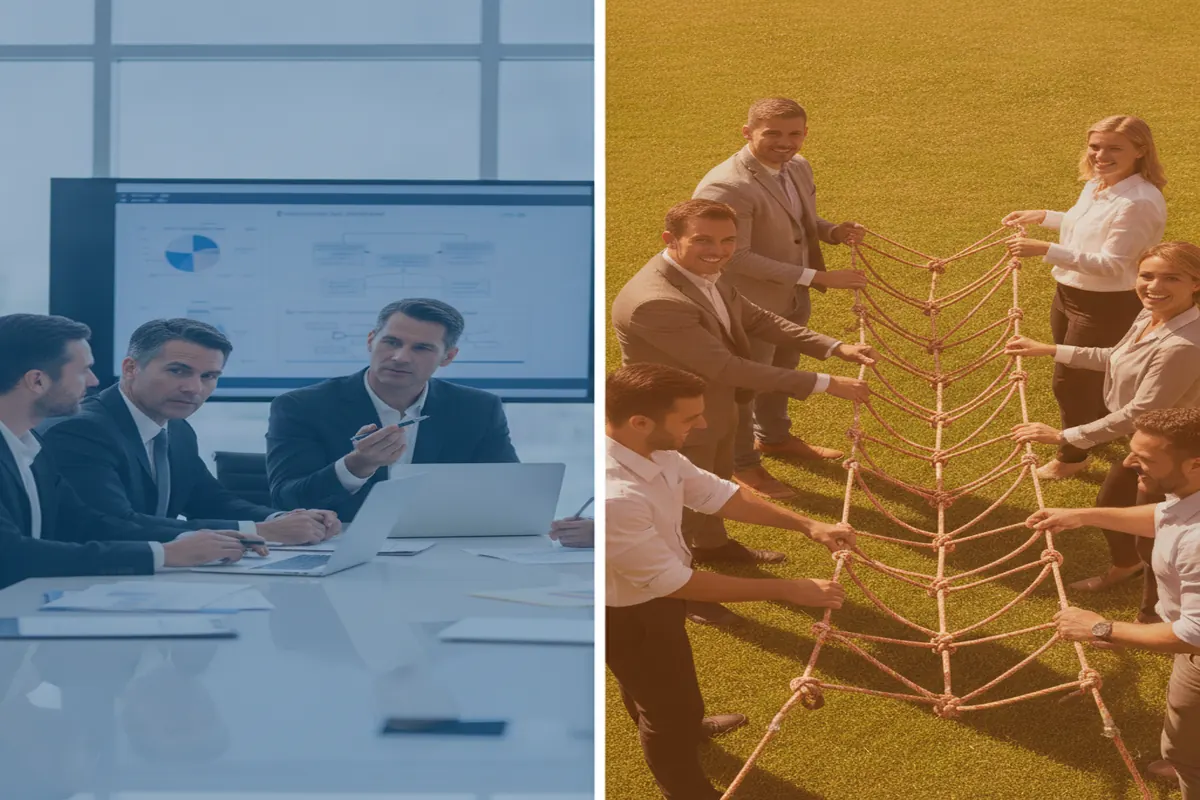
Middle management and team building, while both vital for organizational success, serve distinct purposes within a company’s operational and cultural framework. Middle management refers to the layer of managers who execute strategic plans from senior leadership by overseeing specific departments, projects, or teams, focusing on performance, resource allocation, and accountability. Team building, conversely, is a process or series of activities designed to enhance group cohesion, communication, collaboration, and collective problem-solving skills among team members, regardless of their hierarchical position, to improve overall team effectiveness. Understanding these fundamental differences is crucial for any organization looking to optimize its structure and cultivate a thriving work environment.
Quick Summary
- Middle management focuses on strategic execution, resource allocation, and performance oversight
- Team building emphasizes collaboration, trust, and collective problem-solving among peers
- Middle management defines hierarchical roles and responsibilities, while team building is a process to enhance group dynamics
- Choosing between them depends on current organizational challenges and strategic objectives
Decoding Middle Management vs. Team Building: Fundamental Differences
The distinction between middle management and team building lies at the core of their function, scope, and desired outcomes. While middle management is an established organizational role with defined responsibilities, team building is a dynamic process or initiative aimed at improving group dynamics.
Middle Management: The Backbone of Strategy Execution
Middle managers are the critical link between senior leadership’s vision and the frontline workforce’s execution. Their responsibilities typically include:
-
Translating Strategy: Interpreting high-level strategic goals into actionable plans for their teams. This often involves a deep understanding of Business Strategy Essentials and Strategic Planning Professional principles.
-
Resource Allocation: Managing budgets, personnel, and other resources to achieve departmental objectives.
-
Performance Management: Setting performance targets, monitoring progress, conducting appraisals, and providing feedback. This aligns closely with Effective Performance Review and Performance Measurements, Continuous Improvement and Benchmarking.
-
Coaching and Development: Guiding team members, fostering their professional growth, and addressing performance gaps. Programs like The Management Essentials and Leadership and Management Skills for Supervisors are directly relevant.
-
Communication Hub: Facilitating information flow both upwards to senior executives and downwards to line managers and individual contributors. Effective High Impact Business Communication is paramount here.
-
Change Management: Implementing organizational changes within their sphere of influence, requiring skills often taught in Advanced Conflict Resolution and Change Management Strategies.
Team Building: Cultivating Collective Strength
Team building, on the other hand, is not a role but a deliberate effort to improve how groups of individuals work together. Its focus is on the collective, rather than individual, performance. Key aspects include:
-
Enhancing Communication: Developing open, honest, and effective communication channels within a team. This resonates with Advanced Communication and Interpersonal Skills and Communication Essentials.
-
Building Trust: Fostering psychological safety and mutual reliance among team members.
-
Fostering Collaboration: Encouraging shared responsibility, mutual support, and joint problem-solving. Relevant courses include Advanced Teamwork and Cooperation Skills and Building Task Leadership Skills.
-
Conflict Resolution: Equipping teams with strategies to constructively address disagreements and maintain harmony. Negotiating and Dispute Resolutions is a key skill.
-
Clarifying Roles and Goals: Ensuring every team member understands their contribution to the collective objective and how their role integrates with others.
-
Motivation and Engagement: Boosting morale and commitment through shared experiences and recognition of collective achievements.
To further clarify, here’s a side-by-side comparison:
Unlocking Potential: The Distinct Benefits of Effective Middle Management and Robust Team Building
Both middle management and team building contribute significantly to an organization’s health and productivity, but they do so through different mechanisms, delivering unique sets of benefits. Recognizing these allows organizations to strategically invest in areas that align with their most pressing needs.
Benefits of Strong Middle Management:
Effective middle management is a cornerstone for operational excellence and strategic agility. Its benefits cascade throughout the organization:
-
Efficient Strategy Execution: Middle managers translate abstract corporate goals into concrete, executable tasks for their teams, ensuring that strategic initiatives are not just conceptual but are actively implemented and monitored. This directly impacts how effectively a company achieves its Strategic Planning, Development and Implementation.
-
Improved Performance and Accountability: By setting clear expectations, providing regular feedback, and managing resources, middle managers drive individual and team performance, holding staff accountable for their contributions. This is central to Managing Employee Performance.
-
Talent Development and Retention: They serve as coaches and mentors, identifying and nurturing talent within their teams, which is crucial for succession planning and reducing employee turnover. Programs like Leadership Development Programme empower them in this area.
-
Enhanced Communication Flow: Acting as conduits, they ensure vital information flows smoothly between senior leadership and frontline employees, preventing miscommunications and fostering transparency. This highlights the importance of Communication, Coordination and Leadership.
-
Effective Resource Optimization: Middle managers are responsible for allocating and managing resources efficiently within their departments, ensuring projects stay on budget and on schedule. This ties into Budgeting and Cost Control and Successful Planning, Organising and Delegating.
-
Operational Stability and Problem Solving: They are often the first to identify and address operational issues, acting as critical problem-solvers who maintain day-to-day stability and escalate complex challenges appropriately. Advanced Problem Solving and Decision Making is a vital skill for them.
Benefits of Robust Team Building:
Team building initiatives foster a positive work environment and enhance collective capabilities, yielding benefits that strengthen the organizational fabric:
-
Boosted Morale and Motivation: Engaging team building activities can significantly improve employee morale, making individuals feel more connected, valued, and motivated to contribute.
-
Stronger Communication and Trust: Dedicated team building efforts create opportunities for team members to interact outside of daily tasks, fostering better understanding, empathy, and open communication. This is fundamental to Mastering Communication, Negotiation and Presentation Skills.
-
Improved Collaboration and Synergy: When teams learn to work together more effectively, they can leverage diverse strengths, leading to more innovative solutions and efficient project completion. This supports Advanced Teamwork and Cooperation Skills.
-
Enhanced Problem-Solving Capabilities: Cohesive teams are better equipped to tackle complex challenges, drawing on collective intelligence and a shared sense of purpose.
-
Reduced Conflict and Increased Harmony: By building rapport and understanding, team building can preempt and mitigate workplace conflicts, creating a more harmonious and productive environment. Success under Pressure – Emotional Intelligence, Conflict Management and Negotiations is a highly relevant area.
-
Greater Employee Engagement and Retention: Employees who feel part of a strong, supportive team are more likely to be engaged with their work and committed to the organization, reducing attrition rates.
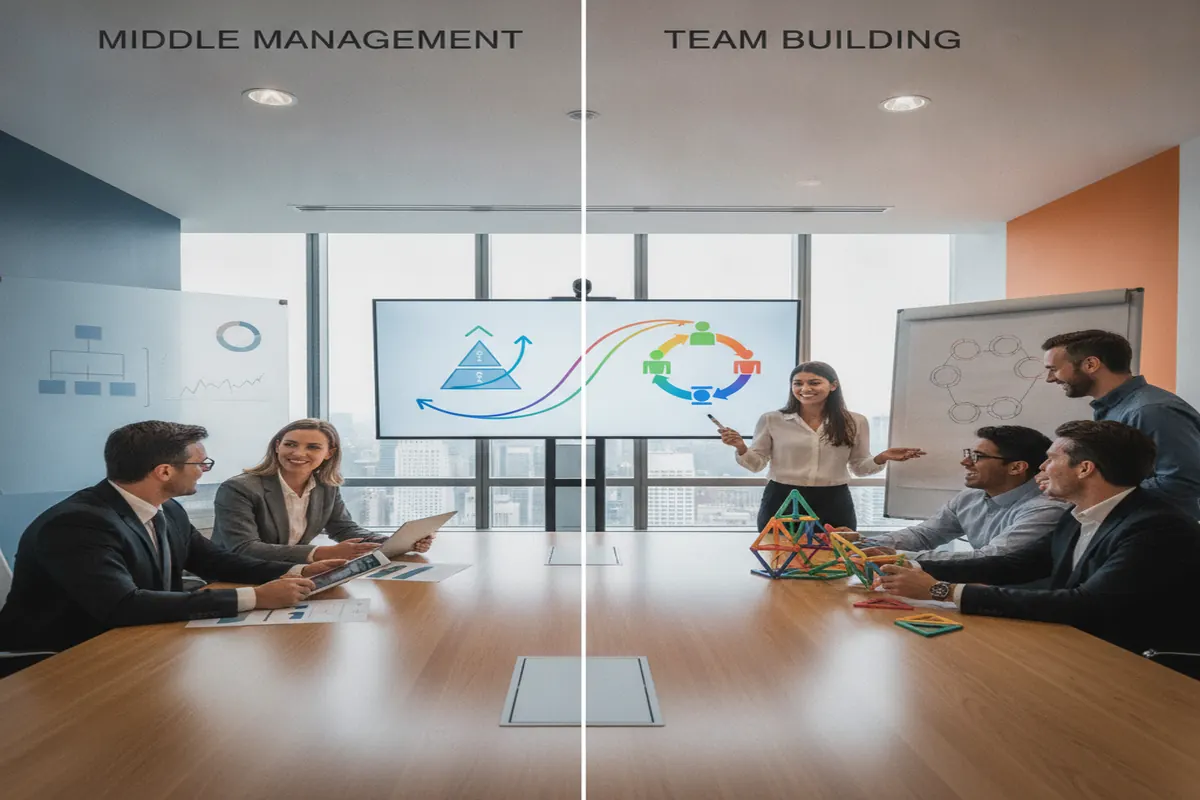
Targeting Impact: Who Benefits Most from Middle Management & Team Building Initiatives?
Understanding the primary beneficiaries of middle management development and team building initiatives helps organizations tailor their investments for maximum impact. While both ultimately serve the entire organization, their direct targets differ significantly.
Who is Middle Management Development Suitable For?
Investing in middle management development is particularly crucial for organizations that are:
-
Scaling Rapidly: As companies grow, the complexity of operations increases, demanding stronger leadership at the departmental level to maintain control and drive execution.
-
Undergoing Significant Change: During periods of Organizational Change, such as mergers, acquisitions, or digital transformations, middle managers are instrumental in guiding their teams through uncertainty and implementing new processes. Training in Advanced Management – Achieving Superior Performance and Strategic Success becomes critical.
-
Struggling with Strategy Execution: If senior leadership’s vision isn’t translating into tangible results, it often points to a gap in middle management’s ability to plan, delegate, and monitor effectively. Courses like Strategy Design Bootcamp can address this.
-
Experiencing High Turnover in Leadership Roles: Developing a strong pipeline of middle managers can ensure leadership continuity and provide opportunities for internal promotion, reducing reliance on external hires. The Leadership Development Programme is ideal here.
-
Aiming for Improved Performance Metrics: Organizations focused on specific KPIs, productivity gains, or cost efficiencies will benefit from managers equipped with skills in Performance Measurements, Continuous Improvement and Benchmarking and Key Performance Indicators and Optimisation.
Primary Beneficiaries of Middle Management Focus:
-
Senior Executives: They gain confidence that their strategic vision will be effectively implemented.
-
Frontline Employees: They receive clearer direction, better support, and more effective coaching.
-
The Organization as a Whole: Benefits from improved operational efficiency, better resource utilization, and stronger leadership at all levels.
Who are Team Building Initiatives Suitable For?
Team building is essential for any organization, but it offers particular advantages in situations where:
-
Teams are New or Restructured: Forming new teams or integrating members from different departments benefits immensely from activities designed to quickly build rapport and establish working norms.
-
Communication Breakdowns Occur Frequently: If there’s a lack of open dialogue, misunderstandings, or silos between team members, targeted team building can bridge those gaps. Communication Essentials is foundational.
-
Morale or Engagement is Low: A disengaged workforce often signals a lack of connection or purpose. Team building can reignite enthusiasm and a sense of belonging.
-
Conflict is Prevalent: Unresolved interpersonal conflicts can cripple team productivity. Team building activities can provide a safe space to address underlying issues and develop conflict resolution skills. Advanced Conflict Resolution and Change Management Strategies offers deeper insights.
-
Innovation and Creativity are Stifled: Teams that trust each other and communicate openly are more likely to share ideas freely, leading to greater innovation. Courses like Leadership, Creativity and Peak Performance can enhance this.
-
Cross-Functional Collaboration is Required: In projects requiring multiple departments to work together, team building helps break down barriers and foster a unified approach.
Primary Beneficiaries of Team Building Focus:
-
Individual Team Members: They experience improved relationships, reduced stress, and a stronger sense of belonging.
-
Project Teams: They achieve better project outcomes through enhanced collaboration and problem-solving.
-
The Organizational Culture: Benefits from a more positive, supportive, and collaborative environment.
Choosing Your Focus: When to Prioritize Middle Management or Team Building
Deciding whether to prioritize investments in middle management development or team building requires a strategic assessment of your organization’s current challenges, long-term goals, and existing strengths. It’s rarely an either/or scenario in the long run, but immediate priorities can shift.
Decision Framework: Assessing Your Organizational Needs
Use the following framework to guide your decision-making:
-
Identify Core Challenges:
- Management Issues: Are strategic directives consistently failing to translate into action? Are departments underperforming despite clear goals? Is there a lack of accountability? Is talent development stagnant? (Prioritize Middle Management)
- Team Dynamics Issues: Are there frequent communication breakdowns, conflicts, or silos between team members? Is morale low? Is collaboration poor, leading to missed deadlines or subpar project outcomes? (Prioritize Team Building)
-
Evaluate Strategic Objectives:
- Growth & Expansion: If your goal is rapid expansion, market penetration, or significant scaling, strong middle management is essential to build and manage new teams and operations.
- Innovation & Agility: If your focus is on fostering a culture of innovation, adapting quickly to market changes, or improving cross-functional project success, robust team building is paramount. Continuous Innovation and Process Improvement relies on collaborative teams.
- Operational Efficiency: For streamlining processes, reducing waste, and improving productivity, both are important, but middle management often leads the charge in implementing Quality Management Essentials and Introduction to Business Process Improvement.
-
Assess Current Capabilities:
- Existing Management Skills: Do your current middle managers possess the necessary skills in leadership, delegation, Performance Management – Setting Objectives and Conducting Appraisals, and Effective Organisational Leadership?
- Team Cohesion & Maturity: How well do your teams already collaborate? Is there a high level of trust and psychological safety? What is the existing team culture like?
-
Consider Budget and Resources:
- Middle management training often involves longer-term development programs, coaching, and succession planning.
- Team building can range from one-off events to ongoing workshops and culture-building initiatives.
When to Prioritize Middle Management:
-
Your organization is experiencing rapid growth or significant structural change.
-
There’s a noticeable gap between strategic vision and operational execution.
-
Key performance indicators (KPIs) are consistently missed at the departmental level.
-
Managers are struggling with delegation, performance reviews, or employee development.
-
There’s a lack of clear accountability or effective resource management.
When to Prioritize Team Building:
-
New teams are forming, or existing teams are undergoing significant membership changes.
-
There are frequent interpersonal conflicts, communication issues, or a lack of trust within teams.
-
Employee morale, engagement, or retention rates are declining.
-
Innovation and cross-functional collaboration are critical but lacking.
-
Teams are struggling to achieve collective goals despite individual competence.
Ultimately, the most effective approach often involves a blend. Strong middle managers are often the ones who champion and facilitate effective team building within their departments. Conversely, highly cohesive teams make a middle manager’s job more effective by improving communication and shared responsibility.
Beyond the Basics: Common Pitfalls in Implementing Middle Management & Team Building Strategies
Even with good intentions, organizations often stumble when implementing strategies for middle management development or team building. Recognizing these common mistakes can help you avoid them and ensure your investments yield genuine returns.
Common Mistakes in Middle Management Development:
-
Promoting Technical Experts Without Leadership Training: A common pitfall is promoting top individual contributors to management roles without providing them with adequate leadership, communication, or people management skills. This can lead to frustration for both the new manager and their team.
- Avoid by: Implementing structured leadership development programs like Leadership and Management Skills for New Manager and Supervisor before or immediately after promotion.
-
Lack of Clear Role Definition and Authority: Middle managers sometimes operate in a “sandwich” position without clear authority or defined responsibilities, leading to ambiguity and ineffective decision-making.
- Avoid by: Clearly outlining their scope, decision-making power, and accountability.
-
Ignoring Continuous Development: Management skills aren’t static. Failing to provide ongoing training in areas like Change Management, Strategic Crisis Management, or Developing Emotionally Intelligent Management and Leadership Skills leaves managers ill-equipped for evolving challenges.
-
Micromanagement (or the opposite, Abdication): Both extremes are detrimental. Micromanagement stifles initiative, while complete abdication leaves teams adrift.
- Avoid by: Training managers in effective delegation, trust-building, and Coaching for Success.
-
Insufficient Support from Senior Leadership: If senior executives don’t visibly support and empower their middle managers, their effectiveness will be limited.
- Avoid by: Ensuring clear communication lines, mentorship, and opportunities for middle managers to contribute to strategic discussions.
Common Mistakes in Team Building Initiatives:
-
Treating Team Building as a One-Off Event: A single annual “fun day” without follow-up or integration into daily work rarely has lasting impact.
- Avoid by: Approaching team building as a continuous process, integrating principles of Advanced Teamwork and Cooperation Skills into daily operations.
-
Lack of Clear Objectives: Organizing activities without a specific goal (e.g., “improve communication,” “resolve conflict,” “boost morale”) makes it difficult to measure success or tailor the experience.
- Avoid by: Conducting a needs assessment to identify specific team challenges and setting measurable objectives for each initiative.
-
Forcing Participation or Inappropriate Activities: Mandatory, unengaging, or culturally insensitive activities can backfire, leading to resentment rather than cohesion.
- Avoid by: Offering a variety of activities, considering team preferences, and ensuring they align with the team’s culture and needs.
-
Ignoring Underlying Issues: Team building can’t fix deep-seated organizational or interpersonal problems (e.g., toxic leadership, unfair policies). It’s a supplement, not a cure-all.
- Avoid by: Addressing fundamental issues through other HR and management interventions first.
-
Failure to Debrief and Apply Learnings: Without reflection and discussion on how the lessons from team building can be applied back in the workplace, the experience often remains isolated.
- Avoid by: Incorporating debriefing sessions and creating action plans for applying new insights.
Synergy in Action: How Middle Management and Team Building Intersect for Organizational Success
While distinct, middle management and team building are not mutually exclusive; in fact, their synergy is a powerful driver of organizational success. When effectively integrated, they create a robust framework that supports both strategic execution and a thriving workplace culture.
How Middle Managers Drive Effective Team Building:
Middle managers play a pivotal role in fostering a positive team environment and ensuring that team building efforts translate into tangible results. They are often the The Practical Leader – Developing and Leading High Performing Teams.
-
Role Modeling: Managers who demonstrate strong communication, collaboration, and trust set the standard for their teams. Their behavior directly influences team dynamics.
-
Facilitating Opportunities: They can actively create opportunities for team members to collaborate, share ideas, and build rapport during regular work, not just in dedicated events. This includes structuring projects for interdependency.
-
Championing Initiatives: When middle managers visibly support and participate in team building activities, it signals their importance to the team, increasing engagement and buy-in.
-
Resolving Conflicts and Mediating: Effective managers possess the skills to address interpersonal conflicts promptly and constructively, preventing them from escalating and eroding team cohesion. Advanced Conflict Resolution and Change Management Strategies is a critical skill set here.
-
Providing Feedback and Coaching: Managers can use insights from team building activities to provide targeted coaching on areas like active listening, constructive feedback, and Advanced Communication and Interpersonal Skills.
-
Aligning Team Goals with Individual Strengths: A skilled middle manager understands their team members’ strengths and weaknesses, leveraging this knowledge to assign roles and foster collaboration that maximizes collective output.
How Strong Teams Empower Middle Management:
A well-built, cohesive team significantly lightens the load on middle managers and amplifies their effectiveness:
-
Improved Communication Channels: When team members communicate openly and honestly with each other, it reduces the need for the manager to constantly mediate or disseminate information. This directly supports High Impact Business Communication.
-
Enhanced Problem-Solving: Cohesive teams are more likely to self-organize and collaboratively solve problems, reducing the burden on the manager to be the sole problem-solver.
-
Increased Accountability: In a high-trust environment, team members are more likely to hold each other accountable, fostering a culture of shared responsibility that complements the manager’s oversight.
-
Higher Morale and Productivity: Engaged and motivated teams are inherently more productive, making it easier for managers to meet departmental objectives and Performance Measurements, Continuous Improvement and Benchmarking.
-
Greater Adaptability to Change: Teams with strong bonds and communication are more resilient and adaptable when faced with Organizational Change, requiring less intensive intervention from managers.
-
Support for Strategic Execution: When teams understand and are committed to shared goals, they become powerful engines for executing the strategies cascaded by middle management, translating vision into reality.
The ideal scenario is one where middle managers are trained not only in their core leadership and performance management duties but also in the art of fostering strong team dynamics. Conversely, team building initiatives should be designed with the support and active involvement of middle management to ensure their integration into the daily work fabric. This holistic approach ensures a thriving, productive, and resilient organization.
Strategic Readiness: Essential Checks Before Investing in Management or Team Development
Before committing resources to either middle management development or team building, a thorough assessment of your organization’s readiness and specific needs is crucial. This due diligence ensures that your investment is targeted, effective, and yields measurable returns.
Checklist for Strategic Investment:
-
Conduct a Needs Assessment:
- Management Gaps: Are there consistent complaints about leadership, delegation, or accountability from direct reports or senior leadership? Are project deadlines frequently missed due to poor oversight? (Look at The Essentials of Leadership and The Management Essentials areas).
- Team Dynamics Gaps: Are surveys indicating low morale, high conflict, or poor communication? Are cross-functional projects failing due to lack of collaboration? (Consider Advanced Teamwork and Cooperation Skills and Communication Essentials).
- Recommendation: Use surveys, 360-degree feedback, performance reviews, and direct interviews to pinpoint specific areas for improvement.
-
Define Clear Objectives:
- Management Development: What specific skills do you want your managers to acquire (e.g., improved delegation, better conflict resolution, strategic thinking)? How will you measure the impact on their teams’ performance? (Refer to Competency-Based Management).
- Team Building: What specific outcomes are you aiming for (e.g., improved cross-departmental collaboration, increased trust, enhanced problem-solving)? How will you quantify these changes? (Think about HR Metrics and Analytics for measuring soft skills impact).
- Recommendation: Objectives should be SMART (Specific, Measurable, Achievable, Relevant, Time-bound).
-
Assess Organizational Culture and Readiness:
- Is your culture supportive of continuous learning and development?
- Are employees generally open to participating in such initiatives, or is there cynicism?
- Is senior leadership visibly committed to and championing these efforts?
- Recommendation: Gauge cultural receptiveness through internal communications and leadership buy-in. A lack of readiness can undermine even the best programs.
-
Evaluate Available Resources and Budget:
- Do you have the financial resources for high-quality training programs or ongoing team development activities?
- Do you have internal facilitators or will you need external expertise?
- What time commitment can you realistically ask from employees without impacting productivity negatively?
- Recommendation: Be realistic about what your budget and internal capacity can support, prioritizing quality over quantity.
-
Plan for Measurement and Evaluation:
- How will you track the effectiveness of your middle management training (e.g., changes in team performance, employee satisfaction scores, project success rates)?
- How will you measure the impact of team building (e.g., improved survey scores on collaboration, reduced conflict incidents, enhanced innovation metrics)?
- Recommendation: Establish baseline metrics before implementation and plan for follow-up evaluations to demonstrate ROI. This might involve tracking Key Performance Indicators and Optimisation.
-
Consider Integration with Existing Programs:
- Can new initiatives be integrated with existing leadership development, Continuous Employee Development and Empowerment, or performance management systems?
- Recommendation: Look for synergies to avoid fragmented efforts and maximize impact. For instance, middle managers trained in The Practical Leader – Developing and Leading High Performing Teams can then lead internal team building.
By diligently working through this checklist, organizations can make informed decisions, ensuring their investments in middle management and team building are strategic, impactful, and aligned with their overarching goals.
Expert Insight
“The most successful organizations recognize that middle management and team building are not competing priorities but rather two sides of the same coin. Effective middle managers are the architects of high-performing teams, translating strategic intent into collaborative action. Conversely, robust team dynamics empower managers to achieve greater impact. It’s a symbiotic relationship where investment in one invariably strengthens the other, ultimately driving both operational excellence and a resilient, engaged workforce.”
— Industry experts confirm that a holistic approach yields superior results.
Key Terms
-
Middle Management: The layer of management between senior executives and frontline employees, responsible for executing strategic plans, managing resources, and overseeing specific departments or teams.
-
Team Building: A process or set of activities designed to improve group cohesion, communication, collaboration, and collective problem-solving skills among team members.
-
Change Management: The systematic approach to dealing with the transition or transformation of organizational goals, processes, or technologies.
-
Performance Management: The process of ensuring that employees are working effectively to achieve the organization’s goals, including setting objectives, monitoring progress, and providing feedback.
-
Collaboration: The act of working jointly with others to produce or create something, emphasizing shared effort and mutual support towards a common goal.
How Can BMC Training Support Your Professional Growth?
At BMC Training, we understand the critical interplay between effective middle management and robust team building in today’s dynamic business environment. Whether you’re an aspiring leader, an experienced manager seeking to refine your skills, or an organization aiming to cultivate a more cohesive workforce, our comprehensive programs are designed to empower you.
For those looking to excel in their middle management roles, consider our specialized courses such as:
-
The Management Essentials: Providing foundational skills for effective leadership.
-
Leadership and Strategic Impact: Equipping managers to drive organizational success.
-
Performance Measurements, Continuous Improvement and Benchmarking: Enhancing your ability to monitor and optimize team and departmental performance.
-
Leadership and Management Skills for Supervisors: Tailored for those stepping into or developing their supervisory capabilities.
If your focus is on strengthening team building and fostering collaboration, our programs include:
-
Advanced Teamwork and Cooperation Skills: Designed to build highly effective and synergistic teams.
-
Communication, Coordination and Leadership: Essential for improving interpersonal dynamics and collective action.
-
The Practical Leader – Developing and Leading High Performing Teams: A practical approach to cultivating a thriving team environment.
-
Advanced Communication and Interpersonal Skills: Crucial for enhancing trust and resolving conflict within teams.
BMC Training’s expert-led courses provide practical, real-world insights and actionable strategies to address your specific needs. From Strategic Planning Professional to Developing Emotionally Intelligent Management and Leadership Skills, we offer a spectrum of learning opportunities to help you build the leadership capabilities and team cohesion necessary for sustained success. Invest in your growth and your organization’s future with BMC Training.
Frequently Asked Questions
Q: What is the primary difference between a middle manager and a team leader?
Q: Can a middle manager also be involved in team building?
Q: Is team building only about fun activities outside of work?
Q: Which should an organization prioritize first: developing middle managers or investing in team building?
Q: How can you measure the effectiveness of middle management development?
Q: What are the risks of neglecting both middle management development and team building?