

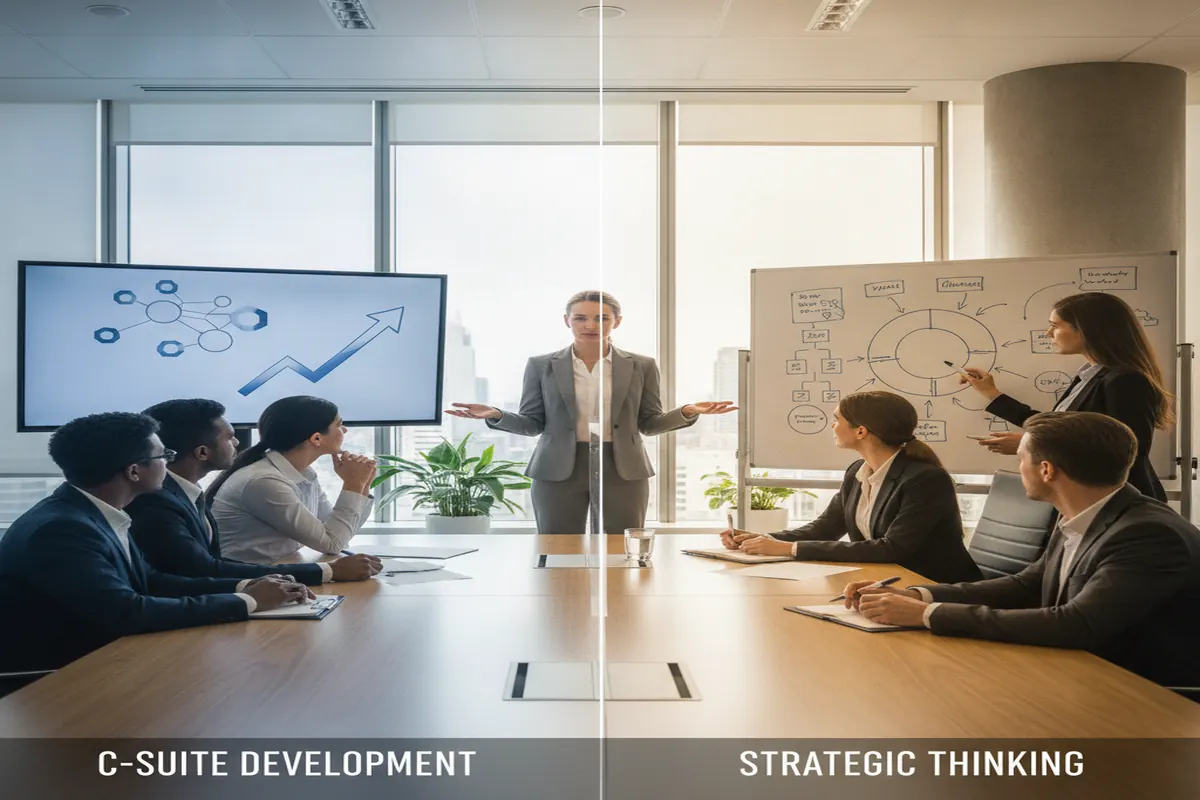
C-suite development is a comprehensive approach to cultivating the holistic capabilities required for executive leadership, encompassing everything from financial acumen and operational mastery to emotional intelligence and stakeholder management. In contrast, strategic thinking is a specific cognitive process focused on foresight, innovation, and long-term planning to navigate complex business environments and achieve organizational objectives. While distinct in their primary focus, both are indispensable for effective executive performance, with the choice between them or their integration depending on an individual’s career stage, existing skill set, and specific organizational needs.
Quick Summary
- C-suite development focuses on holistic leadership capabilities
- strategic thinking emphasizes cognitive processes for future direction
- development builds broad executive acumen, while strategic thinking sharpens foresight
- choosing depends on career stage and specific skill gaps
What are the Core Differences Between C-Suite Development and Strategic Thinking?
Understanding the fundamental distinctions between C-suite development and strategic thinking is crucial for any aspiring or current executive looking to enhance their capabilities. While often discussed in similar contexts of high-level leadership, they represent different dimensions of executive growth and organizational contribution.
C-suite development is an overarching framework designed to mold individuals into well-rounded, effective leaders capable of overseeing an entire enterprise. It’s about building the complete package of skills, behaviors, and perspectives needed to operate at the highest echelons of an organization. This includes not just technical expertise but also critical soft skills and a deep understanding of organizational dynamics.
Strategic thinking, on the other hand, is a specific, high-value cognitive skill set. It’s the ability to analyze complex situations, anticipate future trends, identify opportunities and threats, and formulate innovative pathways to achieve long-term goals. While a vital component of executive leadership, it is a focused discipline rather than a holistic development program.
Here are the key distinctions that set them apart:
-
Scope and Breadth:
- C-suite development covers a broad spectrum of executive competencies, including leadership, finance, operations, human capital, and stakeholder relations. It aims for holistic growth.
- Strategic thinking focuses on a specific cognitive process: the ability to analyze, foresee, plan, and innovate for future success. Its scope is narrower, concentrated on foresight and direction.
-
Primary Objective:
- C-suite development aims to produce effective, influential, and resilient executive leaders who can drive overall organizational performance and culture.
- Strategic thinking aims to enhance an individual’s capacity to shape the future direction of a business, ensuring long-term competitiveness and growth.
-
Skill Set Focus:
- C-suite development cultivates a diverse range of skills such as emotional intelligence, communication, negotiation, change management, crisis leadership, and decision-making under pressure. (See also: Developing Emotionally Intelligent Management and Leadership Skills, The Essentials of Leadership).
- Strategic thinking sharpens abilities in systems thinking, critical analysis, scenario planning, innovation, strategic foresight, and problem-solving. (Consider: Strategy Design Bootcamp, Strategic Planning Professional).
-
Time Horizon:
- C-suite development often prepares leaders for immediate and ongoing executive challenges, alongside future succession.
- Strategic thinking inherently focuses on the medium to long-term future, identifying trends and crafting plans for sustainable advantage.
-
Nature of Learning:
- C-suite development typically involves experiential learning, coaching, mentorship, and exposure to diverse business functions.
- Strategic thinking often involves analytical frameworks, case studies, simulations, and structured methodologies for problem-solving and planning.
C-Suite Development vs. Strategic Thinking: A Head-to-Head Comparison
To further clarify the distinctions, let’s examine C-suite development and strategic thinking side-by-side. This comparison will highlight where each discipline places its emphasis and what outcomes you can expect from pursuing one over the other, or ideally, both.
While C-suite development is about becoming a better leader across all dimensions, strategic thinking is about becoming a better architect of the future. A truly effective C-suite executive will naturally embody strong strategic thinking capabilities as a core part of their broader development.

Who Benefits Most? Tailoring Your Choice to Your Career Stage and Goals
Deciding between C-suite development and strategic thinking, or understanding how to integrate them, largely depends on your current role, career aspirations, and the specific challenges you face. Both are invaluable, but their optimal timing and emphasis can vary significantly.
When C-Suite Development is Your Priority
C-suite development programs are typically designed for individuals who are either already in executive roles or are on a clear path to them. They address the multifaceted demands of leading an entire organization or a significant division.
-
Aspiring C-Level Executives: If your goal is to reach the CEO, CFO, COO, or similar positions, a comprehensive C-suite development program is essential. It provides the breadth of knowledge and skills – from governance to global market dynamics – necessary to operate effectively at that level. This includes mastering aspects like Effective Organisational Leadership and Leadership and Strategic Impact.
-
Current C-Suite Members: Even seasoned executives benefit from ongoing development. These programs can help refine existing skills, introduce new leadership paradigms (e.g., digital transformation leadership), foster continuous innovation, and provide networking opportunities with peers facing similar high-level challenges.
-
Leaders with Broad Operational Responsibilities: Individuals managing multiple departments or entire business units, who need to understand the interplay of various functions (finance, marketing, HR, operations) to achieve synergy and drive overall growth.
-
Individuals Needing Holistic Skill Enhancement: If you recognize a need to develop a wider range of competencies beyond just technical or strategic skills, such as improving emotional intelligence, executive presence, or advanced communication, C-suite development offers a structured pathway.
When Strategic Thinking is Your Priority
Strategic thinking training is highly beneficial for a broader range of professionals, particularly those whose roles require them to contribute significantly to an organization’s future direction and competitive positioning.
-
Mid-to-Senior Managers: Professionals who are tasked with developing departmental or business unit strategies, translating corporate vision into actionable plans, and driving innovation within their scope. They need to cultivate strong acumen in market analysis and future planning.
-
Business Strategists and Analysts: Roles explicitly focused on market research, competitive analysis, trend forecasting, and formulating strategic recommendations. These individuals are the architects of future plans.
-
Entrepreneurs and Startup Founders: Those building new ventures require a strong ability to envision market opportunities, adapt to change, and craft resilient business models from the ground up.
-
Innovation Leaders: Individuals responsible for fostering new ideas, developing new products or services, and identifying disruptive technologies. Their role is inherently tied to strategic foresight.
-
Project and Program Managers: For those leading complex initiatives, strategic thinking ensures projects align with overarching organizational goals and contribute to long-term value. (Consider: Project Management Essentials, Strategic Planning, Communication, Measurement and Implementation).
In many cases, the most effective approach is a blended one. A strong foundation in strategic thinking often precedes or complements a full C-suite development journey, as strategic decision-making is a critical component of executive leadership.
Unlocking Executive Potential: The Benefits of Each Approach
Both C-suite development and strategic thinking offer distinct, powerful benefits that can significantly accelerate professional growth and organizational success. Understanding these advantages helps in making an informed choice about your investment in learning.
The Transformative Benefits of C-Suite Development
Investing in comprehensive C-suite development offers a multifaceted return, shaping not just individual leaders but the very fabric of an organization.
-
Holistic Leadership Mastery: Programs cultivate a broad array of skills, including financial literacy, operational excellence, talent management, and advanced communication, ensuring leaders are proficient across all critical business functions. This leads to better decision-making and overall organizational growth.
-
Enhanced Executive Presence and Influence: Participants learn to command respect, inspire teams, and effectively communicate vision and strategy to diverse stakeholders, both internal and external. This is crucial for navigating complex organizational dynamics.
-
Strategic Acumen and Operational Integration: While distinct from pure strategic thinking, C-suite development integrates strategic principles into a broader operational context, teaching leaders how to translate vision into actionable plans and manage execution effectively. (Related: Smart Leadership – Achieving Strategy through Leadership and Innovation).
-
Robust Network Building: These programs often bring together high-caliber peers from various industries, fostering invaluable networking opportunities, peer learning, and potential collaborations.
-
Improved Organizational Resilience: Leaders developed through these programs are better equipped to handle crises, manage change, and foster an adaptive organizational culture, contributing to long-term stability. (See: Organisational Resilience).
-
Succession Planning and Talent Pipeline: Organizations that invest in C-suite development build a strong internal pipeline of future leaders, reducing reliance on external hires and ensuring leadership continuity.
The Strategic Advantages of Sharpening Strategic Thinking
Developing strong strategic thinking capabilities yields direct benefits that impact an organization’s direction, competitiveness, and capacity for innovation.
-
Superior Decision-Making: Strategic thinkers can analyze complex information, foresee potential outcomes, and make more informed, forward-looking decisions that align with long-term objectives. (Relevant course: Effective Business Decisions Using Data Analysis).
-
Enhanced Competitive Advantage: By anticipating market shifts, identifying emerging trends, and understanding competitor moves, strategic thinkers can position their organizations for sustained competitive edge. This is about cultivating true strategic foresight.
-
Fostering Innovation and Growth: Strategic thinking is the bedrock of innovation. It enables leaders to identify new opportunities, challenge conventional wisdom, and develop disruptive solutions that drive new revenue streams and market expansion. (Consider: Continuous Innovation and Process Improvement).
-
Effective Resource Allocation: With a clear long-term vision, strategic thinkers can prioritize initiatives, allocate capital and talent more efficiently, and ensure resources are directed towards areas with the highest potential return.
-
Increased Organizational Agility: By continuously scanning the environment and developing contingency plans, strategic thinkers contribute to an organization’s ability to adapt quickly to unforeseen challenges and capitalize on new opportunities.
-
Clearer Vision and Direction: Strategic thinking helps define a compelling vision for the future, providing clarity and purpose that can motivate and align teams across the organization.
Choosing Your Path: Key Considerations Before Enrolling
Selecting the right development path, whether it’s C-suite development, strategic thinking, or a combination, requires careful self-assessment and a thorough evaluation of available programs. This decision framework helps ensure your investment aligns with your career goals and yields maximum impact.
A Decision Checklist for Executive Growth
Before committing to any program, consider these critical factors:
-
Assess Your Current Role and Aspirations:
- What are your daily responsibilities? Are they primarily operational, strategic, or a mix?
- What is your next career goal? Is it a broader leadership role, or a more specialized strategic function?
- What kind of impact do you want to make? Enterprise-wide transformation, or focused innovation and direction?
-
Identify Your Core Skill Gaps:
- Do you lack holistic leadership skills (e.g., financial literacy, HR management, stakeholder engagement, emotional intelligence)? If so, C-suite development is likely more appropriate.
- Do you need to sharpen your ability to foresee trends, innovate, or develop long-term plans? If your strategic acumen is the primary area for improvement, focus on strategic thinking.
- Practical Tip: Ask for 360-degree feedback from peers, subordinates, and superiors to get an objective view of your strengths and weaknesses.
-
Evaluate Program Curriculum and Focus:
- For C-suite development: Look for programs that offer a broad curriculum covering leadership, finance, operations, marketing, HR, and global business. Emphasize experiential learning, case studies, and executive coaching.
- For strategic thinking: Seek programs that delve into frameworks like scenario planning, competitive analysis, disruptive innovation, and strategic execution. Ensure there’s a strong emphasis on practical application and real-world problem-solving. (Consider: Strategy Excellence, Advanced Strategic Management).
-
Consider the Program’s Format and Duration:
- Are you looking for an intensive, immersive experience (often characteristic of C-suite programs) or a more focused, shorter-duration course?
- What is your availability? Can you commit to a multi-week or multi-month program, or do you need something more flexible?
-
Research Faculty Expertise and Peer Network:
- Who are the instructors? Do they have real-world executive experience and academic rigor?
- What is the profile of other participants? Networking with high-caliber peers can be as valuable as the curriculum itself.
-
Assess Certification Recognition and Employer View:
- Are the certifications or qualifications from the program widely recognized and respected within your industry or target organizations? (Addresses secondary keyword: “certification is more widely recognized”).
- How do employers view different leadership qualifications in your field? Some industries might prioritize specific strategic certifications, while others value broader executive development. (Addresses secondary keyword: “do employers view different leadership qualifications”).
- Practical Tip: Consult with HR leaders or executive recruiters in your target companies to understand their preferences.
-
Evaluate Return on Investment (ROI):
- What are the expected career outcomes? Will this program help you achieve your next promotion, increase your influence, or open new opportunities?
- What is the financial and time commitment? Ensure the potential benefits justify the investment.
By systematically working through this checklist, you can make a well-informed decision that propels your executive journey forward.
Avoiding Pitfalls: Common Misconceptions and How to Choose Wisely
Navigating the landscape of executive education can be complex, and several common misconceptions can lead individuals down the wrong path. Recognizing these pitfalls is key to making a strategic choice for your professional development.
Misconception 1: Strategic Thinking is Only for “Strategy” Roles
Many believe that strategic thinking is solely the domain of dedicated strategists, consultants, or senior executives. This is a significant oversight. While these roles demand a high degree of strategic acumen, the ability to think strategically is beneficial, if not essential, for nearly all roles within an organization.
-
Why it’s a pitfall: It limits individuals from developing a critical skill that can enhance performance at all levels, from improving project outcomes to fostering innovation in operational roles.
-
How to choose wisely: Recognize that strategic thinking is a mindset and a toolkit that empowers better decision-making and problem-solving, regardless of your job title. Even entry-level professionals can benefit from understanding how their work contributes to the bigger picture.
Misconception 2: C-Suite Development is Just for “Getting a Title”
Some view C-suite development programs merely as a credentialing exercise to validate an executive title, rather than a genuine growth opportunity.
-
Why it’s a pitfall: This mindset devalues the rich learning experience, the development of critical soft skills, and the networking opportunities inherent in these programs. It can lead to superficial engagement and missed growth.
-
How to choose wisely: Approach C-suite development as a profound journey of self-improvement and capability enhancement. Focus on the practical application of learned skills to drive real organizational impact, not just resume building. The true value lies in becoming a more effective leader, not just holding a certificate.
Misconception 3: These Two Disciplines Are Mutually Exclusive
Perhaps the most common error is to view C-suite development and strategic thinking as separate, competing choices. In reality, they are deeply complementary and often interdependent.
-
Why it’s a pitfall: Opting for one while completely neglecting the other creates a significant gap. A C-suite leader without strong strategic thinking skills may struggle to set direction, while a brilliant strategic thinker without broader leadership capabilities may fail to implement their vision effectively.
-
How to choose wisely: Understand that strategic thinking is a vital component within comprehensive C-suite development. Many top-tier executive programs integrate intensive strategic thinking modules. If you’re earlier in your career, start by sharpening your strategic thinking, then build towards holistic C-suite development. For current executives, consider how to continuously refine both.
Misconception 4: Certification is More Important Than Practical Application
While certifications can signal competence, prioritizing them over the actual learning and application of skills is a common trap. (Addresses secondary keyword: “certification is more widely recognized”).
-
Why it’s a pitfall: A certificate without demonstrable skills and real-world impact holds limited value. Employers increasingly look for practical experience and proven results, not just credentials.
-
How to choose wisely: Focus on programs that emphasize practical exercises, case studies, and opportunities to apply learning to your current role. The goal is to internalize knowledge and transform behavior, not just to pass an exam. The true recognition comes from your ability to deliver results.
By sidestepping these common pitfalls, individuals can make more informed decisions, ensuring their executive education genuinely contributes to their long-term career success and organizational value.
Employer Perspectives: How Different Leadership Qualifications Are Viewed
When evaluating leadership qualifications, employers look for evidence of capabilities that align with their organizational needs and strategic objectives. The perception of C-suite development versus strategic thinking qualifications can vary, though generally, a blend of both is highly prized. (Addresses secondary keyword: “do employers view different leadership qualifications”).
The Value of C-Suite Development Qualifications
Employers view comprehensive C-suite development qualifications, particularly from reputable institutions or specialized executive training providers like BMC Training, as indicators of:
-
Holistic Leadership Readiness: These programs signal that an individual has been exposed to a broad spectrum of executive functions, from finance and operations to human capital and governance. This suggests readiness for complex, multi-functional leadership roles.
-
Proven Soft Skills: Employers understand that C-suite roles demand exceptional emotional intelligence, communication, negotiation, and change management skills. Development programs often emphasize these, providing evidence that candidates have cultivated these critical interpersonal and influencing abilities.
-
Strategic Succession Potential: For organizations focused on internal talent pipelines, individuals who have completed C-suite development are often seen as prime candidates for future executive roles, demonstrating a commitment to long-term growth and leadership continuity.
-
Operational Acumen: These qualifications suggest a leader’s ability to not just set vision but also understand the intricacies of execution, resource allocation, and performance optimization across the enterprise.
The Value of Strategic Thinking Qualifications
Qualifications explicitly focused on strategic thinking are highly valued for demonstrating:
-
Foresight and Innovation Capability: Employers seek individuals who can anticipate market shifts, identify new opportunities, and drive innovation. Strategic thinking certifications or course completions validate this crucial acumen.
-
Problem-Solving and Decision-Making Prowess: The ability to analyze complex business challenges, synthesize information, and formulate robust, future-oriented solutions is paramount. These qualifications attest to a candidate’s structured approach to decision-making.
-
Contribution to Business Growth: Companies are always looking for professionals who can directly contribute to their long-term growth and competitive advantage. Strategic thinking skills are seen as a direct driver of these outcomes.
-
Adaptability and Resilience: In a rapidly changing global landscape, professionals who can think strategically are better equipped to navigate uncertainty, pivot when necessary, and build resilient business models.
The Ideal Scenario: A Blended Profile
In today’s dynamic business environment, the most sought-after leaders possess a blend of both. Employers increasingly look for:
-
“Strategic Leaders”: Individuals who not only possess the broad capabilities of a C-suite executive but also demonstrate exceptional strategic foresight and the ability to articulate and execute a compelling vision.
-
“Visionary Executors”: Those who can move seamlessly from high-level strategic planning to detailed operational oversight, ensuring that strategic goals are translated into tangible results.
Therefore, while a specialized strategic thinking certification can be a powerful asset for specific roles, a comprehensive C-suite development program that includes robust strategic thinking modules often presents the most compelling profile for top-tier executive positions. It signals an individual who is both capable of leading an organization today and shaping its future tomorrow.
Expert Insight
“The modern C-suite leader isn’t just a manager; they are a visionary architect. While operational excellence and people leadership remain foundational, the ability to think strategically – to anticipate disruption, innovate continuously, and craft a resilient future – has become non-negotiable. True C-suite development now intrinsically weaves strategic foresight and agile decision-making into its core curriculum, recognizing that these aren’t separate skills but integrated facets of executive impact.”
— Industry experts confirm that the integration of strategic thinking within broader leadership development is a key trend in executive education.
Key Terms
-
C-Suite Development: A holistic approach to enhancing the comprehensive skills, knowledge, and behaviors required for top-tier executive leadership roles (e.g., CEO, CFO, COO) across various organizational functions.
-
Strategic Thinking: A cognitive process involving critical analysis, long-term foresight, pattern recognition, and innovative problem-solving to define future direction and achieve sustained competitive advantage.
-
Executive Leadership: The ability to guide and inspire an organization towards its vision and goals, making high-level decisions, managing complex challenges, and fostering a productive culture.
-
Strategic Foresight: The capacity to anticipate future trends, identify potential opportunities and threats, and prepare an organization to adapt and thrive in evolving environments.
-
Emotional Intelligence (EQ): The ability to understand and manage one’s own emotions, and to perceive, understand, and influence the emotions of others, critical for effective leadership and interpersonal relations.
-
Acumen: The ability to make good judgments and quick decisions, particularly in a specific domain like business or strategy.
How Can BMC Training Support Your Professional Growth?
At BMC Training, we understand the intricate demands of modern executive leadership and the critical role that strategic thinking plays in achieving sustained organizational success. Whether you are an aspiring C-level executive, a seasoned leader seeking to refine your capabilities, or a professional aiming to sharpen your strategic acumen, our comprehensive portfolio offers tailored solutions designed to meet your specific development needs.
Our C-suite development pathways, such as “The Leadership Development Programme,” “Leadership Excellence in Handling Pressure and Stress,” and “Advanced High Performance Leadership,” are meticulously crafted to cultivate the holistic skills required for top-tier executive roles. These programs delve into areas like emotional intelligence in leadership, effective stakeholder management, and operational mastery, ensuring you develop a well-rounded executive profile.
For those specifically focused on enhancing their strategic thinking capabilities, BMC Training offers specialized courses like “Strategy Design Bootcamp,” “Strategic Planning Professional,” “Strategic Planning, Communication, Measurement and Implementation,” and “Smart Leadership – Achieving Strategy through Leadership and Innovation.” These programs equip you with the frameworks, tools, and methodologies to foster strategic foresight, drive innovation, and make impactful decision-making that fuels organizational growth.
We provide a blend of theoretical knowledge and practical application, delivered by experienced field specialists, ensuring that your learning translates directly into real-world impact. Explore our extensive offerings to find the ideal program that aligns with your career aspirations and helps you become the visionary leader your organization needs.
Frequently Asked Questions
Q: Is C-suite development only for current executives?
Q: Can strategic thinking be learned, or is it an innate talent?
Q: Which certification is more widely recognized by employers?
Q: Do employers view different leadership qualifications equally?
Q: Is it possible to pursue both C-suite development and strategic thinking?
Q: What’s the typical duration of these programs?