

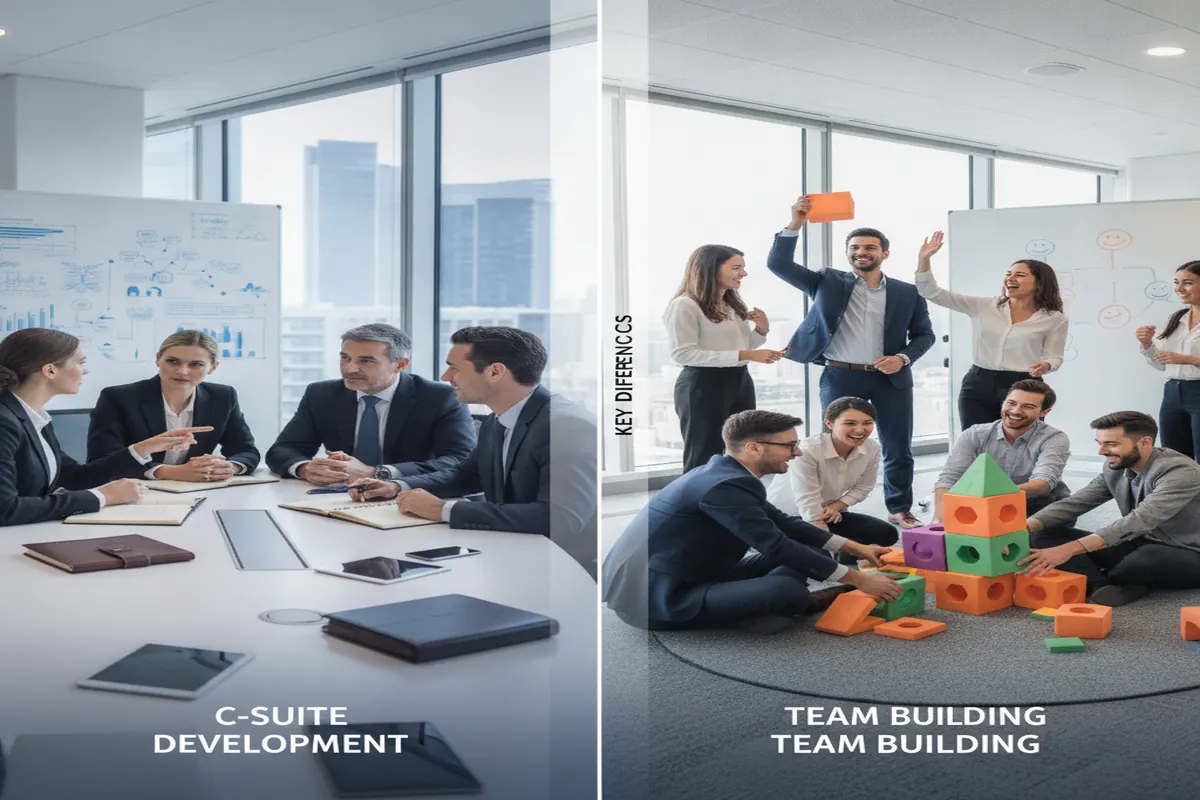
C-suite development and team building are distinct yet complementary strategies for organizational growth, each targeting different levels and objectives within a company. C-suite development focuses on enhancing the strategic capabilities, leadership acumen, and governance skills of top executives to drive enterprise-wide vision and complex decision-making. In contrast, team building aims to improve collaboration, communication, and cohesion among operational or cross-functional teams, fostering a more productive and harmonious working environment. Understanding these core differences is essential for organizations to strategically invest in the right initiatives for sustained success.
Quick Summary
- C-suite development focuses on enhancing strategic leadership capabilities for top executives
- Team building aims to improve collaboration and efficiency within operational teams
- The primary distinction lies in scope, objectives, and participant level
- Choosing between them depends on specific organizational needs—strategic leadership gaps or operational synergy challenges
What are the fundamental differences between C-Suite Development and Team Building initiatives?
The distinction between C-suite development and team building is crucial for any organization aiming to optimize its human capital investments. While both contribute to overall organizational health and performance, they operate on different scales, address varying needs, and employ diverse methodologies. C-suite development is inherently about shaping the architects of the organization’s future, equipping them with the foresight and resilience required for top-tier leadership. Team building, on the other hand, is about refining the operational machinery, ensuring that the gears mesh smoothly and efficiently.
Here’s a detailed comparison of their key aspects:
For example, a C-suite development program might involve an executive coach working with a CEO to refine their global market entry strategy and improve their board communication skills. This is a highly individualized, strategic intervention. Conversely, a team building exercise for a marketing department might involve a day-long workshop focused on improving cross-functional campaign coordination through interactive games and problem-solving scenarios. The former addresses macro-level leadership, while the latter targets micro-level operational synergy.
Who benefits most from C-Suite Development versus Team Building initiatives?
Understanding the target audience for each type of intervention is paramount to ensure resources are allocated effectively and the desired impact is achieved. Both C-suite development and team building serve crucial roles, but their utility is maximized when applied to the appropriate group within the organizational hierarchy.
C-Suite Development: For the Strategic Architects
C-suite development is primarily designed for the highest echelons of an organization. This includes:
-
Chief Executive Officers (CEOs): To refine their vision, leadership style, and ability to navigate complex global challenges.
-
Chief Financial Officers (CFOs), Chief Operating Officers (COOs), Chief Marketing Officers (CMOs), Chief Human Resources Officers (CHROs), and other C-level executives: To enhance their functional expertise with broader strategic thinking, cross-functional collaboration at the executive level, and governance responsibilities.
-
Senior Vice Presidents and Directors on a C-suite trajectory: To prepare them for the immense responsibilities and unique pressures of executive roles.
-
Board Members: To improve their oversight, strategic input, and understanding of corporate governance.
These individuals benefit from programs that focus on:
-
Strategic Impact: Developing the ability to formulate and execute enterprise-level strategies, often involving complex financial models and market analysis. Relevant BMC Training courses include Strategy Design Bootcamp, Strategic Planning Professional, and Advanced Strategic Management.
-
Leadership and Decision-Making in Crisis: Cultivating the resilience and foresight to lead through periods of significant uncertainty or disruption. Leadership and Decision-Making in Crisis and Emergency Situations is highly pertinent here.
-
Global and Multi-Cultural Leadership: Equipping leaders to manage diverse teams and market dynamics across different geographies. Managing and Leading in a Multi-Cultural Workplace offers valuable insights.
-
Advanced Communication and Negotiation: Mastering the art of influencing stakeholders, negotiating high-stakes deals, and representing the organization effectively. Courses like High Impact Business Communication and Effective Negotiation, Persuasion and Critical Thinking are vital.
Team Building: For Operational Synergy and Collective Action
Team building initiatives are best suited for groups that need to work collaboratively to achieve specific operational goals. This typically includes:
-
Project Teams: To ensure smooth coordination, clear communication, and efficient problem-solving towards project milestones.
-
Departmental Units: To foster a cohesive work environment, improve internal communication channels, and enhance daily operational efficiency.
-
Cross-Functional Teams: To bridge communication gaps, build trust, and align objectives between departments that must collaborate on shared initiatives.
-
New Teams: To accelerate bonding, clarify roles, and establish effective working norms right from the start.
These groups benefit from programs that emphasize:
-
Communication and Coordination: Improving how team members share information, provide feedback, and align their efforts. Communication Essentials and Advanced Communication and Interpersonal Skills are foundational.
-
Problem Solving and Decision Making: Empowering teams to collectively identify issues, brainstorm solutions, and make effective decisions. Advanced Problem Solving and Decision Making is a key area.
-
Conflict Resolution and Trust Building: Developing mechanisms to address disagreements constructively and build a foundation of mutual respect. Advanced Conflict Resolution and Change Management Strategies would be beneficial.
-
Enhanced Productivity and Engagement: Creating an environment where team members feel valued, motivated, and committed to collective success. Improving Productivity and Employee Engagement thru Effective Front Line Leadership is directly relevant.
By aligning the development initiative with the appropriate audience and their specific needs, organizations can maximize the return on their investment and foster growth at all levels.
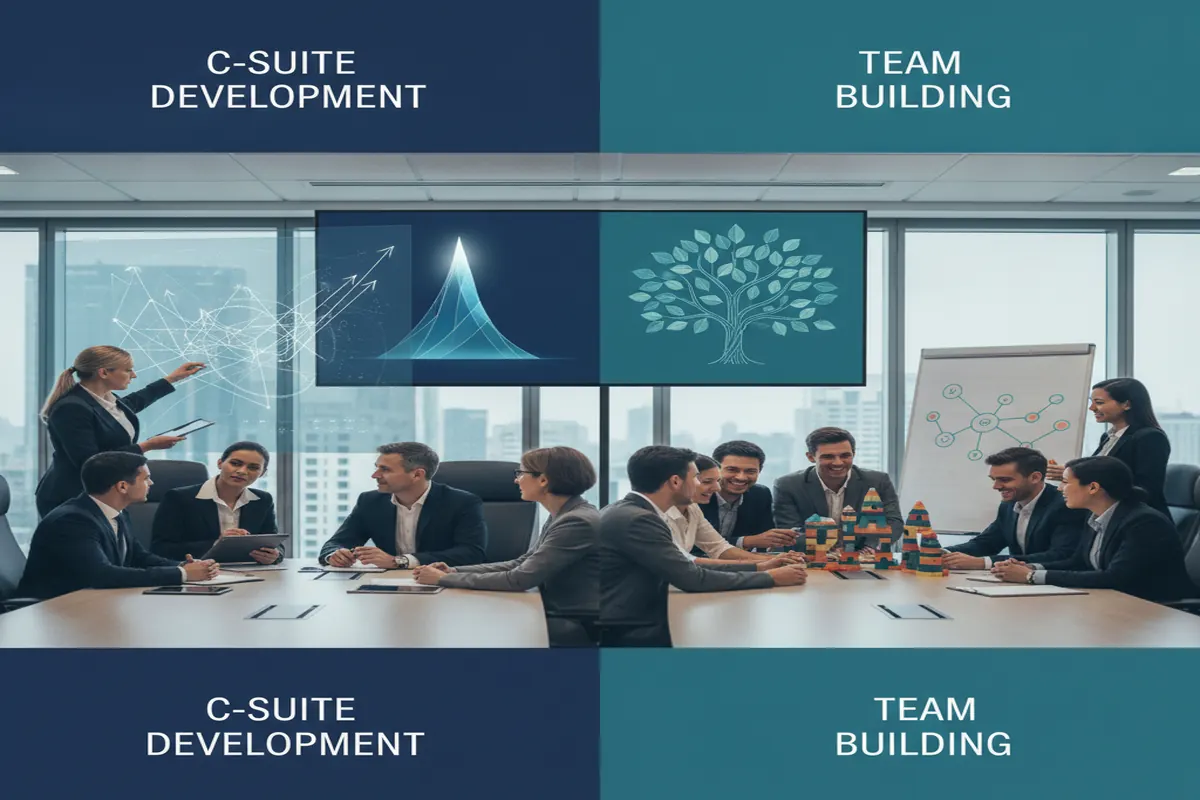
What strategic outcomes can you expect from robust C-Suite Development?
Investing in C-suite development is a strategic imperative, not merely a perk. The outcomes ripple throughout the entire organization, shaping its trajectory, culture, and competitive standing. These programs are designed to cultivate leaders who can not only manage current operations but also anticipate future challenges and opportunities.
Key strategic outcomes include:
-
Enhanced Strategic Vision and Foresight: C-suite leaders develop a sharper ability to analyze complex market trends, anticipate disruptions, and formulate long-term strategies that position the organization for sustainable growth. They move beyond operational concerns to focus on macro-level shifts and competitive advantage. This directly links to courses like Strategy Design Bootcamp and Advanced Strategic Management.
-
Improved Executive Decision-Making Under Pressure: Programs equip leaders with frameworks and tools to make high-stakes decisions with greater confidence, clarity, and speed, even in ambiguous or crisis situations. They learn to balance risk, opportunity, and ethical considerations. Leadership and Decision-Making in Crisis and Emergency Situations is explicitly designed for this.
-
Stronger Organizational Resilience and Adaptability: Developed C-suite leaders foster a culture of agility and continuous improvement, enabling the organization to pivot quickly in response to market changes or unforeseen challenges. They become champions of innovation and proactive change. Organisational Resilience and Continuous Innovation and Process Improvement are highly relevant.
-
Cultivation of a Robust Leadership Pipeline: By developing their own leadership capabilities, C-suite executives become better mentors and sponsors for high-potential individuals, ensuring a steady succession of talent for critical roles. This builds a sustainable leadership ecosystem. The Leadership Development Programme supports this goal.
-
Optimized Corporate Governance and Ethical Leadership: C-suite development instills a deeper understanding of governance responsibilities, regulatory compliance, and ethical decision-making, safeguarding the organization’s reputation and long-term viability. Corporate Control, Regulation and Compliance is a crucial area.
-
Effective Stakeholder Engagement and Influence: Leaders learn to communicate compellingly with investors, board members, employees, and external partners, building trust and garnering support for strategic initiatives. High Impact Business Communication and Strategic Stakeholder Management Essentials are invaluable.
Real-world scenario: Consider a global manufacturing company facing rapid technological disruption and increased competition from agile startups. Without a strong C-suite development program, their executive team might be slow to recognize the need for digital transformation, clinging to outdated business models. However, with targeted development focusing on strategic foresight, innovation leadership, and effective change management, the C-suite could proactively invest in new technologies, restructure operations, and foster a culture of continuous learning. This would enable them to launch new product lines, enter emerging markets, and maintain their competitive edge, ultimately securing the company’s future.
How does Team Building drive operational efficiency and collaboration?
While C-suite development steers the ship, team building ensures the engine room runs smoothly and the crew works in perfect synchronicity. Its impact is felt directly at the operational level, translating into tangible improvements in daily workflow, project outcomes, and overall organizational atmosphere.
Key benefits of effective team building include:
-
Increased Team Cohesion and Morale: When team members feel connected and supported, morale naturally improves. This leads to higher job satisfaction, reduced turnover, and a more positive work environment.
-
Enhanced Communication and Information Flow: Team building exercises often focus on breaking down communication barriers, teaching active listening, and encouraging open dialogue. This ensures information is shared effectively, reducing misunderstandings and improving decision-making within the team. Communication Essentials and Advanced Communication and Interpersonal Skills are critical foundations.
-
Improved Conflict Resolution Skills: Teams that have undergone effective building programs are better equipped to address disagreements constructively, transforming potential conflicts into opportunities for growth and innovation rather than sources of division. Advanced Conflict Resolution and Change Management Strategies provides specific tools.
-
Greater Productivity and Project Success: When team members understand their roles, trust each other, and communicate effectively, they can streamline workflows, avoid duplication of effort, and collaborate more efficiently on projects, leading to higher quality outputs and faster completion times. The Practical Leader – Developing and Leading High Performing Teams is directly relevant.
-
Fostering a Culture of Innovation and Problem-Solving: A cohesive team environment where members feel safe to express ideas and take calculated risks encourages creativity and collective problem-solving. They are more likely to generate innovative solutions and adapt to challenges. Creativity, Critical Thinking and Problem Solving supports this outcome.
-
Stronger Employee Engagement and Retention: Feeling like a valued part of a functional team significantly boosts employee engagement. This, in turn, leads to higher retention rates as individuals are more invested in their roles and the organization’s success. Improving Productivity and Employee Engagement thru Effective Front Line Leadership focuses on this aspect.
Practical example: Imagine a software development team struggling with missed deadlines and frequent bugs. The individual developers are highly skilled, but there’s a lack of shared understanding of project priorities, poor communication during code reviews, and an unwillingness to provide constructive feedback. A team building intervention, perhaps a structured workshop focusing on agile methodologies, communication protocols, and peer feedback techniques, could dramatically change this. By engaging in collaborative coding challenges, facilitated discussions on past project failures, and role-playing scenarios for difficult conversations, the team could develop a stronger sense of collective responsibility and improve their daily interactions. The result would be fewer bugs, more accurate project estimates, and a more harmonious, productive work environment.
How to strategically choose between C-Suite Development and Team Building for your organization?
The decision to invest in C-suite development or team building, or indeed both, should be a strategic one, driven by a clear understanding of your organization’s current challenges, long-term goals, and the specific needs of its people. It’s not a matter of one being inherently “better” than the other, but rather which is more appropriate for a given situation.
A Decision Framework for Optimal Investment:
Before committing resources, consider the following checklist:
-
Assess Organizational Health and Priorities:
- Strategic Direction: Does the organization lack a clear vision? Are strategic initiatives failing to gain traction? Is there uncertainty about future market positioning? (Leans towards C-suite development)
- Operational Execution: Are projects frequently delayed? Is there internal conflict or communication breakdowns within teams? Is productivity lower than expected? (Leans towards Team building)
- Culture: Is the overall culture suffering from a lack of leadership direction or poor inter-departmental collaboration? (Could be both, depending on the root cause)
-
Identify the Core Problem and its Level:
- Leadership Gaps: Are executives struggling with complex decision-making, digital transformation, or fostering innovation from the top? (C-suite)
- Collaboration Deficiencies: Are functional teams working in silos? Is there a lack of trust or effective communication among peers? (Team building)
- Succession Planning: Is there a concern about who will lead the organization in 5-10 years? (C-suite)
-
Define Desired Outcomes:
- Long-term Organizational Transformation: Aiming for a fundamental shift in strategy, market presence, or overall leadership effectiveness. (C-suite)
- Immediate Operational Improvements: Seeking to enhance project efficiency, boost team morale, or resolve specific departmental conflicts. (Team building)
-
Consider the Target Audience’s Current State:
- Executive Readiness: Do your C-suite members possess the advanced skills needed for global leadership, strategic negotiation, and organizational resilience? (C-suite)
- Team Dynamics: Do your teams understand their collective purpose, communicate openly, and resolve issues effectively? (Team building)
-
Evaluate Budget and Resources:
- C-suite development programs are often more individualized, intensive, and therefore typically carry a higher per-participant cost due to executive coaching and bespoke strategic content.
- Team building can range from cost-effective in-house exercises to more elaborate off-site events, generally scaling with group size.
Trade-offs to Consider:
-
Cost vs. Impact: While C-suite development can be more expensive, its strategic impact on the entire organization can be profound and long-lasting. Team building offers more immediate, localized improvements in operational efficiency and morale.
-
Depth vs. Breadth: C-suite development delves deeply into individual executive capabilities and strategic foresight. Team building typically focuses on broader group dynamics and collective skill sets.
-
Time Horizon: C-suite development is often a continuous journey, yielding results over months or years. Team building can show quick wins but requires sustained effort to embed changes.
In many progressive organizations, the ideal approach involves a blended strategy. Strong C-suite leadership creates a clear vision and strategic framework, while effective team building ensures that vision is executed efficiently at every level. For example, a C-suite development program might focus on crafting a new strategic plan, while subsequent team building initiatives help various departments align their operational goals and improve cross-functional collaboration to successfully implement that plan.
Common Pitfalls: What to avoid when implementing C-Suite Development or Team Building?
Even with the best intentions, organizations can fall into common traps that undermine the effectiveness of C-suite development and team building initiatives. Recognizing these pitfalls is the first step towards avoiding them and ensuring a valuable return on investment.
Mistakes to Avoid in C-Suite Development:
-
Lack of Clear Objectives and Measurable Outcomes:
- Pitfall: Launching a program without specific goals (e.g., “just to develop leaders”) makes it impossible to gauge success or justify the investment.
- Avoidance: Define what success looks like before starting. Are you aiming for improved strategic planning, better succession rates, or enhanced executive presence? Establish KPIs (e.g., leadership effectiveness scores, strategic project success rates) to track progress.
- Relevant internal topic: Key Performance Indicators and Optimisation.
-
One-Size-Fits-All Approach:
- Pitfall: Treating all C-suite members as if they have identical development needs ignores individual strengths, weaknesses, and functional roles.
- Avoidance: Tailor programs to individual executive profiles, leveraging 360-degree feedback, personal assessments, and executive coaching. A CFO’s development needs might differ significantly from a CMO’s.
- Relevant internal topic: Developing Personal Effectiveness with Positive Skills.
-
Insufficient Follow-up and Integration:
- Pitfall: Completing a program and expecting sustained change without ongoing support, application, or accountability.
- Avoidance: Integrate learning into daily work through action learning projects, peer coaching, and regular check-ins. Ensure executive sponsors champion the application of new skills.
- Relevant internal topic: Continuous Innovation and Process Improvement.
-
Ignoring Organizational Context and Culture:
- Pitfall: Implementing a program that clashes with the existing corporate culture or fails to address specific organizational challenges.
- Avoidance: Ensure the development content is relevant to the organization’s strategic direction, values, and current business environment.
Mistakes to Avoid in Team Building:
-
Treating it as a “One-Off” Event or “Fun Day Out”:
- Pitfall: Viewing team building as a standalone social event with no strategic connection to daily work, leading to temporary boosts in morale but no lasting change.
- Avoidance: Integrate team building into a broader strategy for continuous team development. Follow up with discussions on how lessons learned can be applied to real-world projects.
- Relevant internal topic: Continuous Employee Development and Empowerment.
-
Ignoring Underlying Team Conflicts or Dysfunctions:
- Pitfall: Using team building activities to paper over deep-seated issues like unresolved conflicts, lack of trust, or poor leadership within the team.
- Avoidance: Address root causes of dysfunction first. Team building is most effective when basic trust and respect are already present, or when it’s explicitly designed to address specific, identified conflicts. Advanced Conflict Resolution and Change Management Strategies can be a precursor or integrated element.
-
Lack of Relevance to Daily Work:
- Pitfall: Activities that feel disconnected from the team’s actual responsibilities can be perceived as a waste of time and lead to cynicism.
- Avoidance: Design or select activities that simulate real-world team challenges, require similar problem-solving skills, or directly address observed communication gaps.
- Relevant internal topic: Mastering Team Leadership Skills.
-
Mandatory Participation Without Buy-in:
- Pitfall: Forcing participation in activities that individuals perceive as childish or irrelevant, leading to resentment rather than engagement.
- Avoidance: Communicate the purpose and benefits clearly. Involve team members in the planning process where appropriate, and ensure activities are respectful and inclusive.
By proactively addressing these common pitfalls, organizations can significantly increase the likelihood of successful C-suite development and team building initiatives, ensuring they contribute meaningfully to strategic goals and operational excellence.
What to look for in a quality C-Suite Development or Team Building program?
Selecting the right development program, whether for your executive team or operational units, is a critical decision that impacts long-term organizational success. A high-quality program goes beyond generic content, offering tailored solutions that drive measurable results. When evaluating options, consider these key criteria:
Essential Checks for Both C-Suite Development and Team Building Programs:
-
Alignment with Organizational Goals:
- What to check: Does the program explicitly address your organization’s strategic objectives, cultural values, and current challenges? A generic program might offer good content, but if it doesn’t align with your specific context (e.g., a push for digital transformation, market expansion, or improving internal communication), its impact will be limited.
- Why it matters: Programs should be a strategic tool, not just an activity. They must support your broader business strategy and help achieve tangible outcomes.
-
Expertise and Credibility of Facilitators/Coaches:
- What to check: What are the qualifications, industry experience, and proven track record of the individuals leading the program? Do they have experience working with similar organizations or at the executive level (for C-suite programs)?
- Why it matters: The quality of the delivery directly impacts the learning experience and the credibility of the content. For C-suite development, executive coaches should possess deep business acumen and a strong understanding of complex organizational dynamics. For team building, facilitators need strong group dynamics management and communication skills.
-
Customization and Flexibility:
- What to check: Can the program be tailored to your specific needs, industry, and organizational culture? Are they willing to adapt content, exercises, and timelines?
- Why it matters: Generic programs rarely deliver optimal results. Customization ensures relevance and addresses your unique challenges, leading to higher engagement and more applicable learning.
-
Measurable Outcomes and ROI:
- What to check: Does the provider offer clear metrics or methodologies to measure the program’s effectiveness and demonstrate a return on investment? This could include pre/post assessments, feedback surveys, performance indicators, or 360-degree reviews.
- Why it matters: Demonstrating ROI justifies the investment and allows for continuous improvement of future development initiatives.
- Relevant internal topic: Performance Measurements, Continuous Improvement and Benchmarking.
-
Post-Program Support and Follow-up:
- What to check: What support is offered after the formal program concludes? This might include follow-up coaching sessions, access to resources, peer learning networks, or implementation guidance.
- Why it matters: Sustained change rarely happens from a single event. Ongoing support helps participants embed new skills and behaviors into their daily routines.
Specific Considerations for C-Suite Development Programs:
-
Executive Coaching Component: Look for programs that integrate individualized executive coaching, as this is often the most impactful element for senior leaders.
-
Strategic Content: Ensure the curriculum covers advanced topics relevant to executive leadership, such as Strategic Planning, Development and Implementation, Organizational Resilience, Risk Management, and Advanced Strategic Management.
-
Peer Learning Opportunities: Programs that facilitate interaction and learning among C-suite peers from different organizations can offer invaluable perspectives and networking.
Specific Considerations for Team Building Programs:
-
Relevance to Work Challenges: The activities should ideally mirror real-world team challenges to make the learning transferable.
-
Focus on Specific Skills: Does the program target specific areas like Communication, Coordination and Leadership, Advanced Teamwork and Cooperation Skills, or Advanced Problem Solving and Decision Making?
-
Certification and Recognition: While less critical for team building, some leadership qualifications for team leaders (e.g., Certificate in Leadership and Management Excellence) are more widely recognized and valued by employers as a testament to structured development. Employers view different leadership qualifications based on the depth and scope of the curriculum, with C-suite level certifications often being more intensive and strategically focused than those for front-line team leaders.
By meticulously checking these criteria, organizations can ensure they invest in programs that not only engage participants but also deliver tangible, lasting benefits to the business.
Expert Insight
“The most effective organizations understand that leadership development is not a ‘fix-it’ solution, but a continuous journey of growth for both individuals and the collective. C-suite development sets the strategic compass, ensuring the leadership guiding the enterprise is equipped for future challenges, while robust team building empowers every crew member to contribute efficiently and cohesively to navigate that course. Neglecting either creates a critical imbalance, jeopardizing both innovation and execution.”
— Industry experts confirm that a holistic approach integrating both top-down vision and bottom-up operational excellence is key to sustained organizational success.
Key Terms
-
C-suite Development: Focused programs designed to enhance the strategic capabilities, leadership acumen, and governance skills of an organization’s most senior executives (e.g., CEO, CFO, COO).
-
Team Building: Initiatives and activities aimed at improving collaboration, communication, cohesion, and overall effectiveness within a specific group or team to achieve shared goals.
-
Strategic Alignment: The process of ensuring that all levels and functions of an organization are working in concert towards common overarching strategic objectives.
-
Executive Coaching: A personalized development process where a coach works one-on-one with a senior leader to enhance specific skills, address challenges, and achieve professional goals.
-
Organizational Resilience: The capacity of an organization to absorb stress, recover from disruption, and adapt to changing conditions, often fostered by strong C-suite leadership.
A short comparison to help you make a better decision.
How Can BMC Training Support Your Professional Growth?
At BMC Training, we understand the intricate balance required for comprehensive organizational development, offering a spectrum of programs tailored for both strategic executive leadership and effective team dynamics. Whether your goal is to cultivate visionary C-suite leaders who can navigate complex global landscapes or to empower your teams with unparalleled collaboration and efficiency, our expert-led courses provide practical, real-world insights.
For C-suite development, explore programs like our Leadership and Strategic Impact, Strategy Design Bootcamp, or Advanced Strategic Management to sharpen decision-making, foresight, and governance skills. Our Leadership Development Programme and The Complete Course on Leadership offer comprehensive pathways for aspiring and current executives.
For team building and enhancing operational synergy, consider courses such as Advanced Teamwork and Cooperation Skills, Communication, Coordination and Leadership, or Mastering Team Leadership Skills. These programs are designed to foster stronger communication, effective problem-solving, and a cohesive work environment across all levels of your organization.
BMC Training’s programs, including those on Effective Organisational Leadership, High Impact Business Communication, and Advanced Conflict Resolution and Change Management Strategies, are globally recognized for their depth, practical application, and ability to deliver measurable results. Partner with us to build a future-ready workforce and leadership team that drives sustainable success.
Frequently Asked Questions
Q: What is the primary difference in focus between C-suite development and team building?
Q: Who should typically participate in C-suite development programs?
Q: Can team building programs address serious internal conflicts within a team?
Q: How do organizations measure the ROI of C-suite development programs?
Q: Is it possible for an organization to benefit from both C-suite development and team building simultaneously?
Q: What should I look for in a quality provider for these development programs?